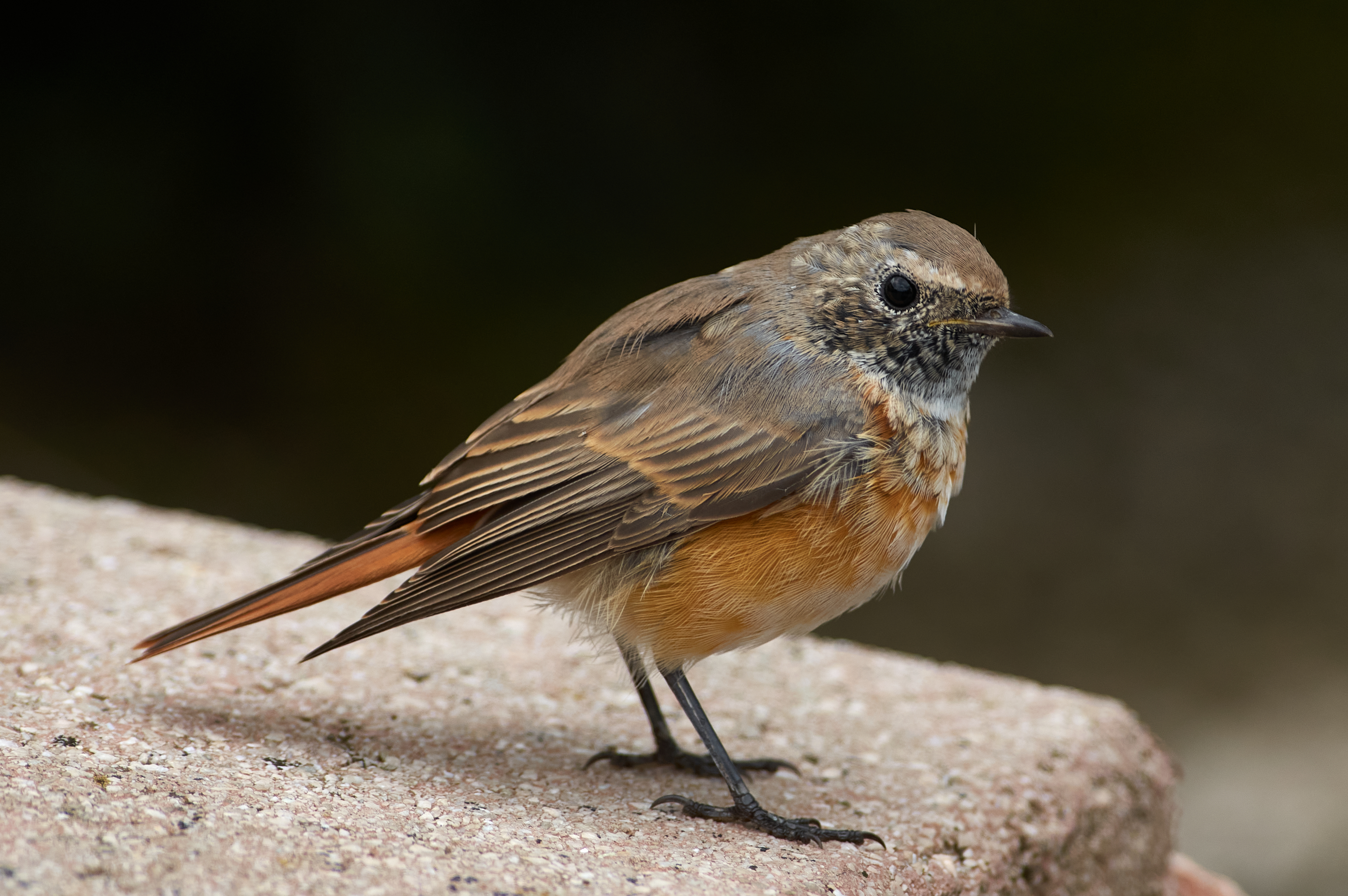
Phoenicurus phoenicurus — Identification, habitats, breeding and occurrence in the Arab region
Identity and recognition
The Common Redstart, Phoenicurus phoenicurus, is a small member of the flycatcher family Muscicapidae. A breeding male combines a white forehead, black face and throat, grey back and orange-red breast and belly. Females are grey-brown above and paler below, with a warm orange wash. The rusty tail is useful in both sexes. Recently fledged young are spotted and mottled rather than miniature versions of the colourful male. Appearance also changes with season: identification should combine several features instead of relying on the breast alone.
Distinguishing similar birds
Females resemble female Black Redstarts, which are generally darker and more uniformly coloured; Common Redstarts tend to look warmer underneath. In males, consider the white forehead, black throat and orange underparts together. Some birds of the subspecies samamisicus have a conspicuous white wing panel, but variation and intergradation make this an insufficient subspecies test on its own. The frequently trembling tail is another helpful clue, although other redstarts share this behaviour.
Habitat, food and behaviour
Breeding habitat includes open woodland and old orchards where cavity-bearing trees stand above accessible feeding ground. On migration, birds also use gardens, agricultural scrub and other semi-open places. A low perch serves as a lookout: the bird drops to the ground or makes a short aerial pursuit, often returning to its perch. Insects, their larvae, spiders and other invertebrates provide food; small fruits may supplement the diet in late summer and autumn. Feeding is diurnal, whereas migration takes place mainly at night.
Breeding and annual cycle
A tree hole, rock crevice or wall cavity can hold the nest; suitable nestboxes are also accepted. The female constructs a cup of plant material with a finer lining. Accounts commonly give five to seven eggs and approximately two weeks of incubation by the female. Young remain dependent after leaving the nest. Breeding dates vary with latitude and habitat; local observations establish the calendar of individual Arab-region populations.
Arab-region distribution and seasonality
This long-distance migrant winters principally in sub-Saharan Africa, including the Sahel. Jordan’s checklist identifies it as a passage migrant. The 2025 Syrian checklist describes widespread passage and limited breeding, including woodland in the northern coastal region. In Saudi Arabia, spring passage is prominent in the north and east from March to May, while autumn passage occurs especially in the west and south from September to November. Wintering is rare in the southwest, notably Tihama. An October sighting therefore fits autumn migration, but does not establish either local winter residence or breeding. Lebanon’s 2020 checklist also documents passage and scarce migrant breeding from late March to early July in open woodland and orchards, especially terraced slopes of the Lebanon and Anti-Lebanon ranges.
Ecology and conservation
By consuming invertebrates, redstarts participate in food webs linking vegetation and soil. Their annual cycle depends on suitable breeding, stopover and wintering habitat. Loss of old trees and cavities, intensive pesticide use, deterioration of winter quarters and drought can affect populations. The global category is Least Concern, which does not imply security everywhere and must not be confused with differing national assessments. Retaining varied orchards, cavity-bearing trees and food-rich resting places supports the bird across its annual cycle.
References
British Trust for Ornithology — BirdFacts: Redstart
Saudipedia — حميراء شائعة
Jordan BirdWatch — Jordan Bird List
Aidek et al. — An Annotated Checklist of the Birds of Syria: Species Diversity, Subspecies, Distribution, and Conservation Status, Jordan Journal of Natural History 12(1), 2025
Mahmiyat — Common Redstart
FSC France — Fiches espèces, 2022: Rougequeue à front blanc
Journal of Ornithology 164 — Subspecies distribution limits and intergradation in Common Redstart, 2023
Ramadan-Jaradi et al. — Updated checklist of the birds of Lebanon, Sandgrouse 42, 2020
Oiseaux.net — Rougequeue à front blanc, expert species account
Photo: Hobbyfotowiki — CC0 1.0.