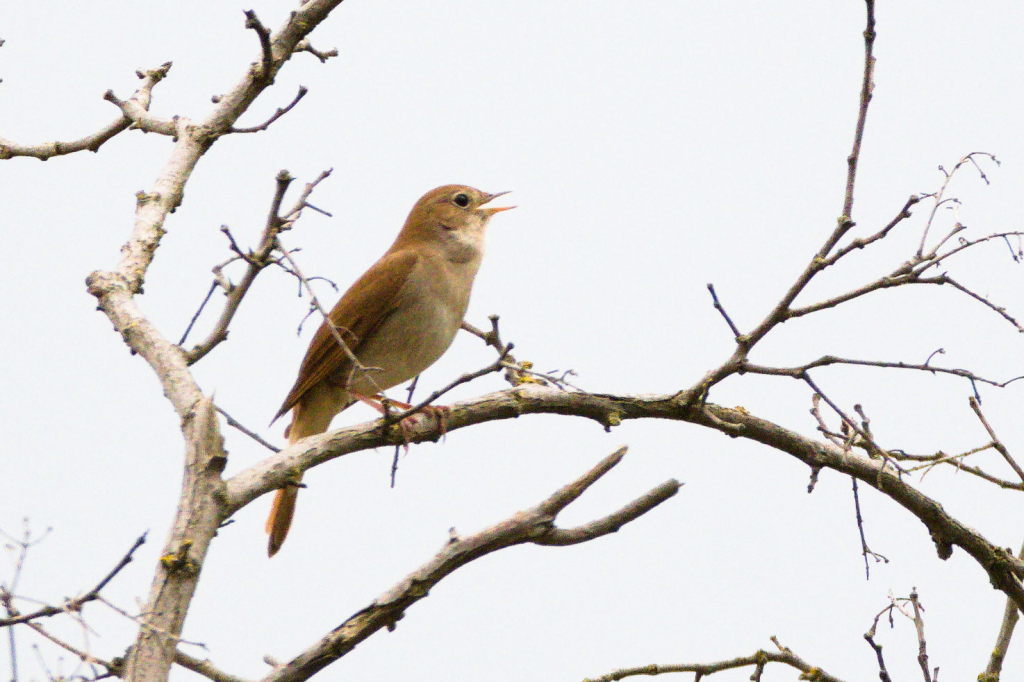
Luscinia megarhynchos
Identity and identification
Common Nightingale Luscinia megarhynchos belongs to Muscicapidae. Warm brown plumage, a rufous tail and paler underparts lack a mask or orange breast. The sexes look similar; its voice is more conspicuous than its appearance. Separation from Thrush Nightingale combines breast markings, colour and sound. It is placed in the order Passeriformes. The IUCN category carried in AviList 2026 is Least Concern (LC).
Habitat, food and behaviour
Dense scrub, woodland edges and orchards with undergrowth provide cover. It takes insects, larvae and spiders from the ground and leaf litter, adding small fruit seasonally. Males may sing at night, particularly before pairing, but also sing by day. Night singing alone does not identify the species.
Breeding and parental care
A low nest is concealed in vegetation or near the ground. The female usually lays four or five eggs and incubates for about 13–14 days. Young leave at roughly 11–13 days, before strong flight develops, and parental care continues. Hidden fledglings should be left where found.
Range and Arab occurrence
It breeds in parts of Europe, western Asia and North Africa, migrating south to sub-Saharan Africa. In Lebanon it is an uncommon migrant breeder and passage migrant. Its prominence in Arabic literature therefore does not imply year-round residence across Arab countries.
Seasonality and observation
The Lebanese checklist places breeding in April–July, spring passage from March to mid-May and autumn passage in September–October. November follows most usual local passage. An undated song recording without a location cannot establish current local occurrence.
Ecological role and conservation
Scrub and leaf litter maintain feeding and nesting sites. Hedge cutting, scrub clearance during breeding and pesticides degrade habitat. Listening from paths and avoiding penetration of dense cover protects an unobtrusive bird whose safety depends strongly on concealment.
References
Ramadan-Jaradi et al. — Updated checklist of the birds of Lebanon, Sandgrouse 42 (2020), 186–238.
British Trust for Ornithology — BirdFacts: Nightingale.
University of Michigan Museum of Zoology — Animal Diversity Web: Luscinia megarhynchos.
AviList Core Team — AviList: The Global Avian Checklist, v2026 (20 October 2026).
Photo: Leonard Wägele — CC0 1.0.