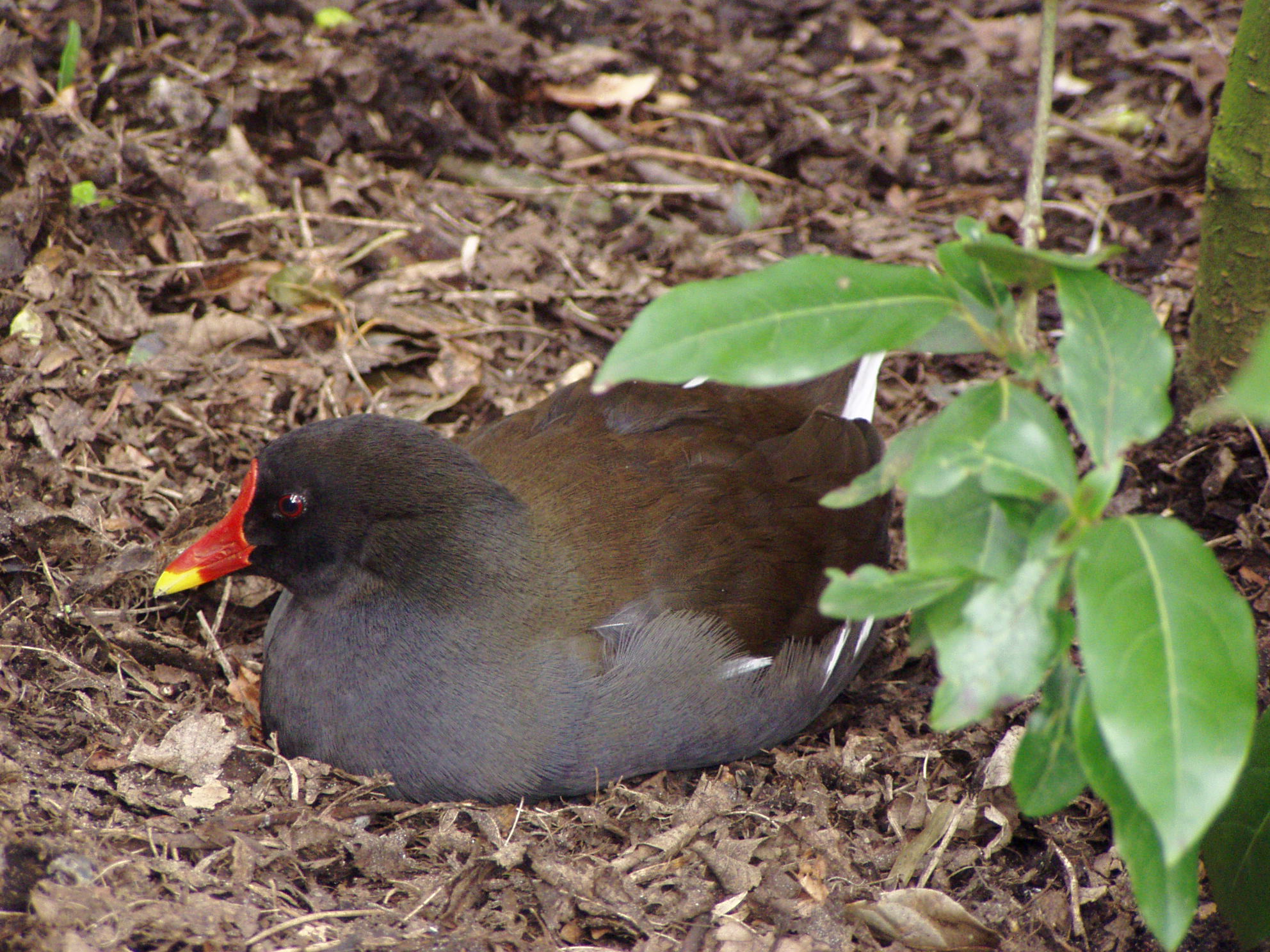
Gallinula chloropus — Identification, habitats, breeding and occurrence in the Arab region
Identity and recognition
The Common Moorhen, Gallinula chloropus, belongs to the rail family Rallidae, not the ducks. It is a compact waterbird about 30–38 cm long, with long greenish legs and elongated toes. Adults have a dark brown back, slaty-black underparts, a white flank line and conspicuous white beneath the tail. The bill and frontal shield are red, with a yellow bill tip. The sexes look alike; size alone is not a dependable way to sex an isolated bird. Juveniles are browner and have a dull bill, lacking the adult’s bright facial pattern.
Lookalikes and behaviour
The adult Eurasian Coot has a white bill and frontal shield rather than the Moorhen’s red-and-yellow bill. Moorhens frequently lift and flick the tail, exposing white markings, and can disappear rapidly into marginal vegetation. Watch both swimming birds and those walking along grassy banks. A bird hiding in reeds is not necessarily absent from a wetland census: repeated patient observations improve detection. The American Common Gallinule, Gallinula galeata, is now treated separately; older accounts that combine the two should not automatically be applied to this species.
Habitat and feeding
Vegetated freshwater margins are particularly important: ponds, marshes, slow waterways, reservoirs and suitable artificial wetlands all provide habitat. Reed-lined treatment-water ponds can support birds in otherwise arid landscapes. Moorhens take plant material, algae and seeds as well as aquatic and terrestrial invertebrates; small vertebrates are also eaten. They pick food from vegetation, the surface and the ground. This varied diet links land and water within the same feeding area. A pond offering both cover and accessible feeding edges differs substantially from a bare ornamental basin.
Breeding and development
Breeding birds defend territories, generally as pairs, though more complex mating arrangements occur. A substantial cup of stems and leaves is usually concealed in vegetation at or just above water. Both adults contribute to nesting and parental care. British nest data give typical clutches of 5–7 eggs and incubation of 20–22 days. Downy chicks leave the nest early but still receive parental care. Flight develops at approximately seven to eight weeks in British data. More than one brood can be raised, and older young sometimes help feed subsequent chicks.
Arab-region occurrence and movements
The species is widespread in the Old World, with resident, dispersive and migratory populations. European ringing evidence places major movements around September and March–April, with some winter recoveries in North Africa. These dates are not an exact Arabian timetable. In Saudi Arabia, artificial wetlands have enabled established breeding populations, alongside seasonal visitors. Kuwait describes local breeding residents and scarce passage and winter visitors. UAE reports document both residents and winter visitors; historical reports place winter arrivals from late August and departures through March. A year-round site may therefore contain changing individuals rather than an entirely sedentary population. Lebanon has resident breeders, with eggs recorded March–late June and immigration from mid-August to late April. Morocco likewise supports residents and winter visitors.
Ecology, threats and status
Moorhens consume both vegetation and small animals and themselves provide food for predators. Wetland drainage, habitat degradation and removal of shoreline cover threaten local populations. Conservation should retain vegetation while maintaining suitable water and open feeding patches. BirdLife’s 2025 global assessment lists Least Concern with a decreasing trend. Distinguish this global category from national abundance. Record juveniles, nests and dependent young separately from simple presence, and observe from a distance so a breeding record does not come at the expense of the nest.
References
Royal Commission for AlUla — Birds of AlUla
RSPB — Moorhen
Sex identification in the moorhen by flow cytometry and morphometric analysis
Yorkshire Wildlife Trust — Coot
British Trust for Ornithology — BirdFacts: Moorhen
The Birds of Saudi Arabia — species accounts
Aramco — The Birds of Saudi Arabia: Life of Birds
KuwaitBirds — Common Moorhen
UAE Birding — Emirates Bird Report 19
UAE Birding — Birds of the United Arab Emirates Annual Report 2014
EURING/CMS — Eurasian-African Bird Migration Atlas: Common Moorhen
BirdLife International — Common Moorhen species factsheet and 2025 Red List assessment
Ramadan-Jaradi and colleagues — Updated checklist of the birds of Lebanon, Sandgrouse 42 (2020)
Squalli and colleagues — Wintering waterbirds of the Saïss–Middle Atlas, Animals (2024)
Photo: Rex — Public domain.