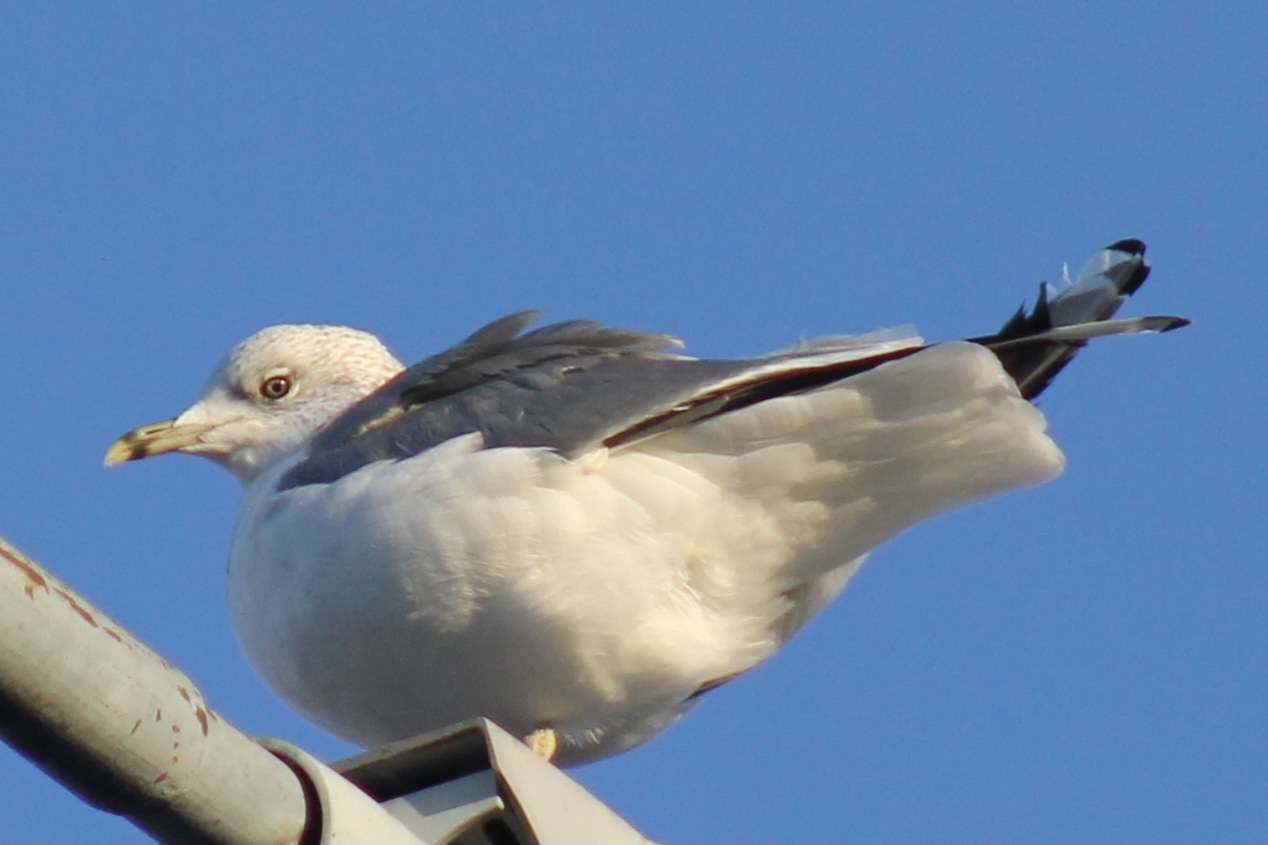
Larus canus
Identity and identification
Common Gull Larus canus belongs to Laridae. Adults have grey upperparts, white underparts, a relatively slender greenish-yellow bill and black wingtips with white markings. The winter head becomes streaked; immature birds differ considerably from adults.
Habitat and food
It takes invertebrates, fish and other foods along shores, fields and water margins. Outside breeding, mixed flocks require identification of individual birds rather than assigning one name to the whole gathering.
Breeding and development
The vegetation nest occupies the ground or a suitable raised site. BTO gives a typical clutch of three eggs, shared incubation of 22–28 days and fledging at about 34–36 days. Growing chicks require food and protection.
Arab occurrence and seasonality
Lebanon’s 2020 checklist separates scarce passage in March and early November to mid-December from widespread common winter presence in December to late February. A few birds remain in summer, which alone does not prove breeding. November falls within the passage period preceding the winter peak.
Observation and conservation
This entry uses Larus canus under AviList 2026. Short-billed Gull Larus brachyrhynchus is separate: its photographs and records must not automatically be transferred here. Clean shores and quiet resting places support the species.
British Trust for Ornithology — BirdFacts: Common Gull · RSPB — Common Gull · Ramadan-Jaradi et al. — Updated checklist of the birds of Lebanon, Sandgrouse 42 (2020) · AviList Core Team — Global Avian Checklist v2026, 20 October 2026
Species illustration: Шухободская Ольга Владимировна — CC0 1.0. · 1 · https://creativecommons.org/publicdomain/zero/1.0/