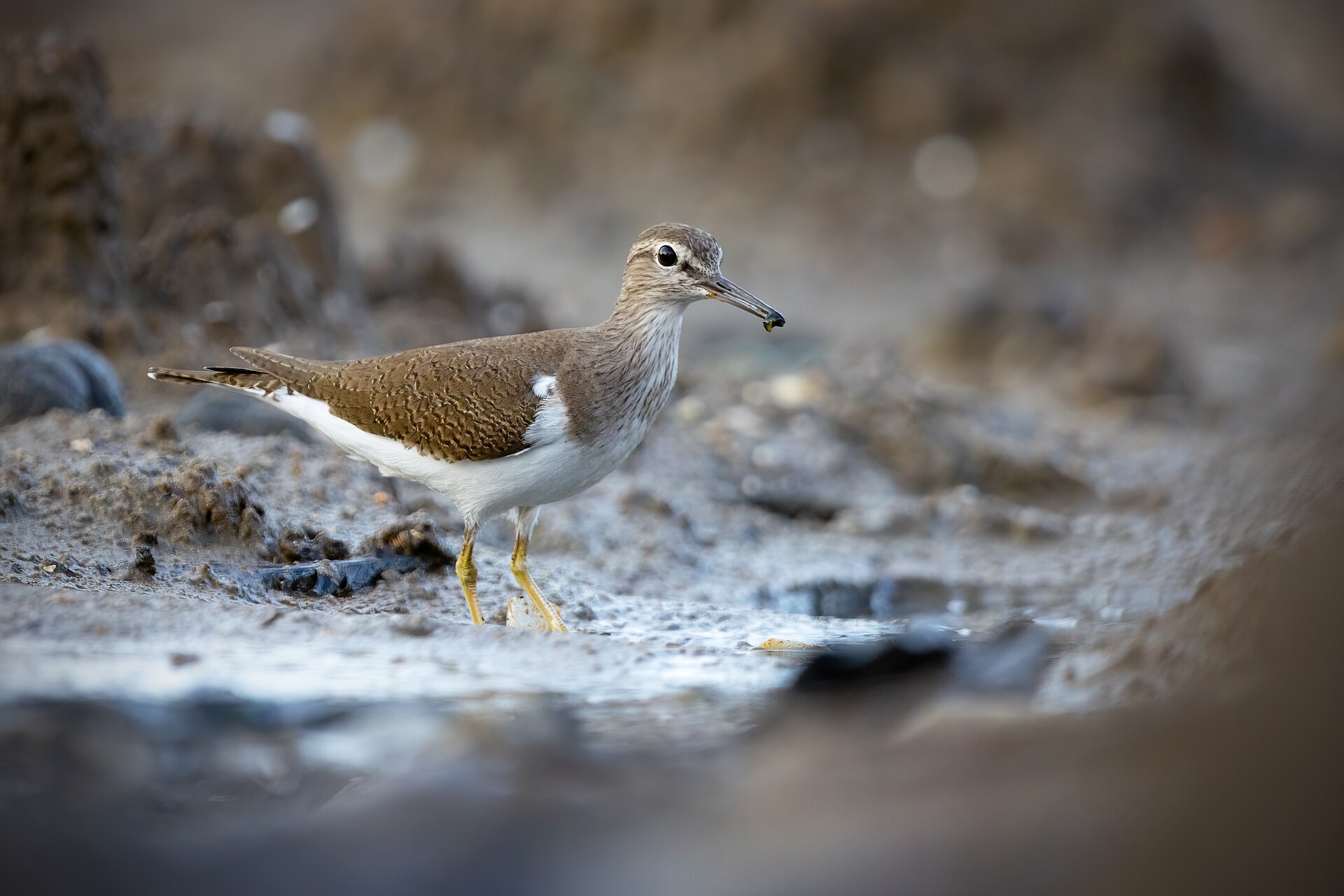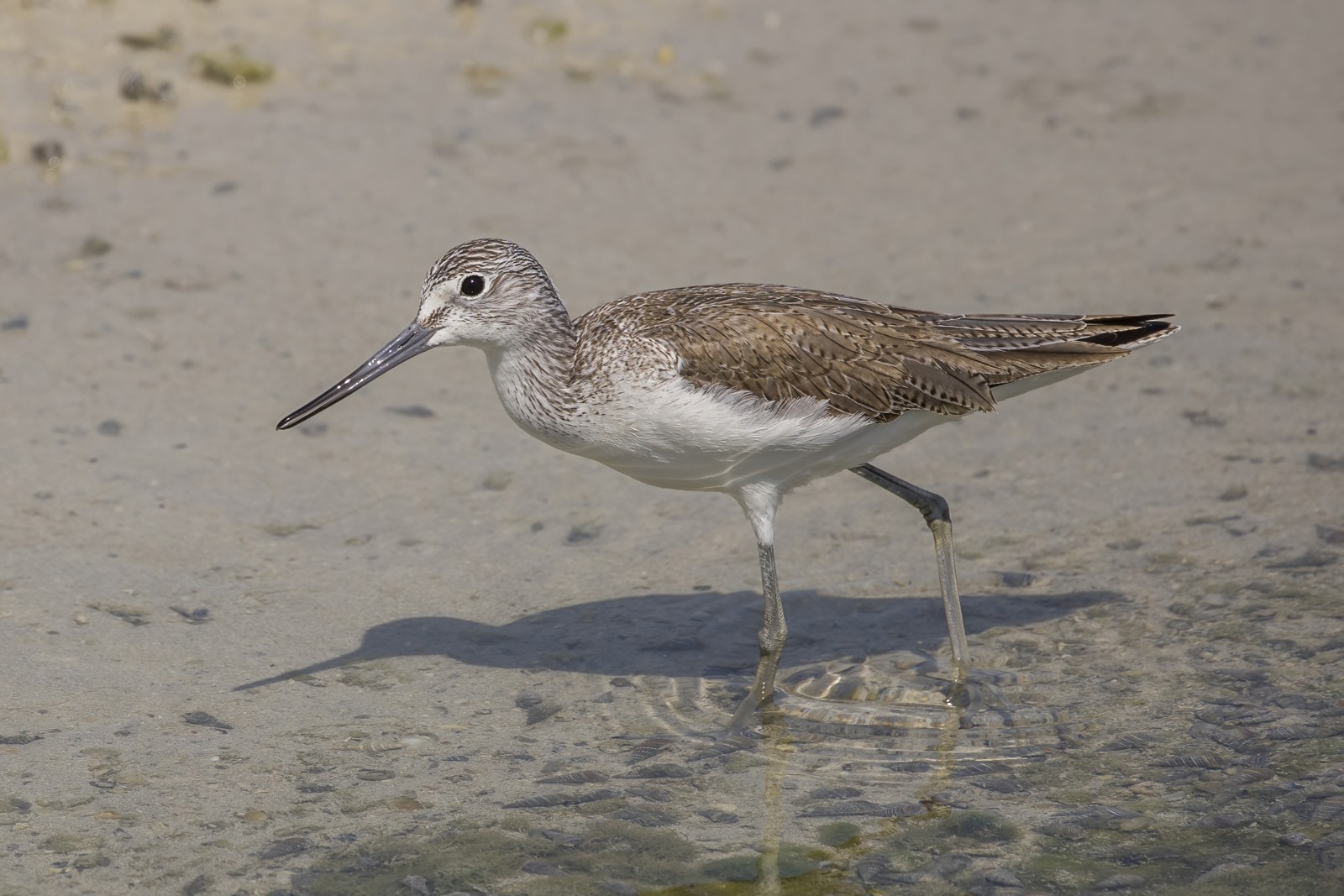
From coasts to inland pools, this migrant combines greenish legs with a bill that turns slightly upwards.
Name and classification
The Common Greenshank, Tringa nebularia, is a wader in the family Scolopacidae and order Charadriiformes. Its French name is Chevalier aboyeur. It is distinct from the Green Sandpiper, Tringa ochropus: similar common names do not denote the same species.
Identification
Its long legs are grey-green or olive, and its relatively robust bill turns slightly upwards towards the tip. Winter birds are grey above and white below, with light streaking on the head and neck. Breeding plumage has stronger contrast and darker markings; juveniles show conspicuous pale edges to their back feathers.
Leg colour alone is insufficient. Marsh Sandpiper, Tringa stagnatilis, is smaller and more delicately built, with a thinner, straighter bill. Green Sandpiper is shorter and more strongly contrasting, dark above and white below. The sexes look similar, and a general photograph does not reliably establish sex.
Habitat, food and behaviour
It uses mudflats, estuaries, lakes and shallow pools, including some artificial wetlands. It takes invertebrates from water and mud and may chase small fish through the shallows. It feeds alone or in small gatherings and can be active by day or night. Its ringing call is often delivered as a sequence of notes.
Life cycle and breeding
It breeds in northern Eurasia where boggy ground and marshes adjoin open woodland or open country. It nests on the ground, usually laying three to four eggs. Chicks can move and seek food early, while still receiving parental protection and care. After breeding, birds move towards passage and wintering areas; some non-breeding individuals remain south of the breeding range in summer.
Arab distribution and autumn relevance
Autumn is a useful time to look for migrants arriving at Arab wetlands or continuing farther south. Wetland references document passage and winter occurrence in Lebanon, while Libyan winter counts establish its presence at coastal and inland sites. It is a regular passage migrant and winter visitor in Oman.
Field studies also document winter occurrence at Moroccan wetlands, while Banc d’Arguin reports record wintering and passage in Mauritania. Egyptian Environmental Affairs Agency reports include it among birds recorded at wetlands. These are local examples, not a map of equal abundance across countries.
In the UAE, records are most numerous between August and April along coasts and at wetlands; a few non-breeding birds may remain in summer. Abundance and migration timing differ across the Gulf, the Levant and North Africa. One country’s observation period must not become a timetable for the entire region. Summer presence alone does not prove breeding.
Ecology and conservation
Migration depends on a connected network of feeding and resting sites; protecting the coast does not replace conserving inland pools and marshes. Globally the species is Least Concern (LC), but the UAE national assessment conducted in 2019 and published in 2021 classified it as Near Threatened (NT): these assessments cover different geographic scales. Coastal land-use change, pollution and disturbance can reduce habitat quality. Watching from a distance, without chasing birds or repeatedly flushing them, allows their behaviour to be observed with less interference.
References
Sources: IUCN and BirdLife International; UAE National Red List of Birds; British Trust for Ornithology; Palm Islands reserve management plan; Atlas of Wintering Waterbirds of Libya; Oman bird list.
Photo: Charles J. Sharp / Wikimedia Commons; Dohat Arad, Bahrain, 18 February 2022. CC BY-SA 4.0; resized and recompressed without cropping or changing the content. · 1 · https://creativecommons.org/licenses/by-sa/4.0/