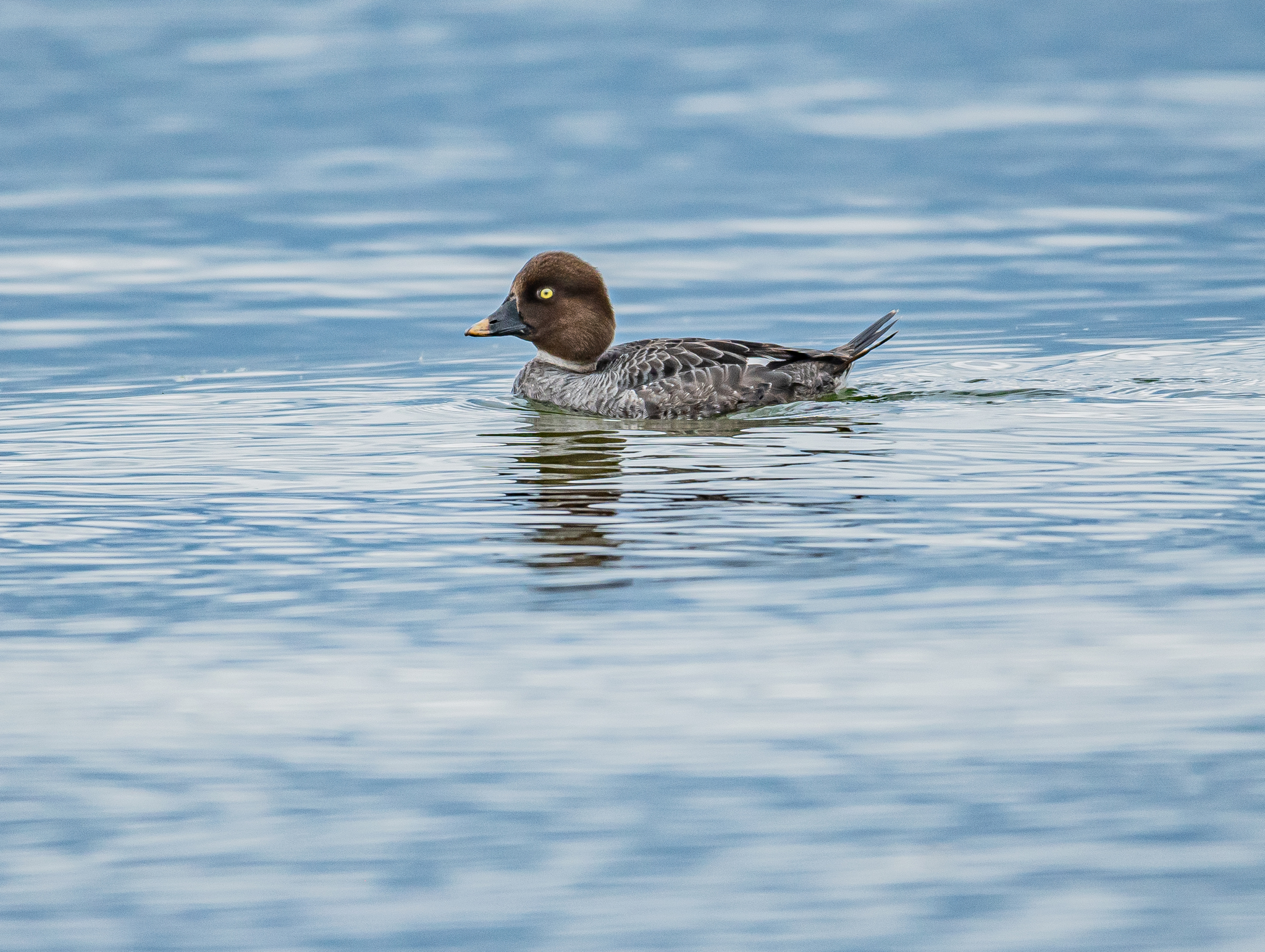
Bucephala clangula
Identity, sex and age
Common Goldeneye, Bucephala clangula, is a compact diving duck with a large-looking head, a short bill and a conspicuous yellow eye in adults. The breeding male has a dark, green-glossed head with a rounded white patch between the bill and eye. White breast and flanks contrast with the black back. The female has a rich brown head and a grey body; her bill often shows yellow near its tip, although the amount changes seasonally. The wings have conspicuous white areas in flight and can produce a whistling sound.
Young birds and eclipse males resemble females more than fully patterned males. Immature eyes can be brownish rather than bright yellow, so the common name does not describe every age. Identification should combine the head shape, bill, eye and plumage. A female Smew is smaller and shows extensive white on the lower face, unlike the Goldeneye's brown head.
Barrow's Goldeneye is the closest relative likely to enter an identification comparison. Its adult male has a crescent-like rather than rounded facial patch and a different balance of black and white. Females are harder to separate, requiring attention to bill and head proportions. Bill colour rules derived from western North American birds should not be applied uncritically to Eurasian birds; this is a case where a regional identification guide matters.
Lakes, coastlines and food
During breeding, Common Goldeneye uses northern lakes and rivers associated with mature woodland. The trees supply nest holes, while the water supplies food. Clear waters with abundant aquatic invertebrates can be especially valuable. The winter habitat is broader, including estuaries, coastal bays, large lakes and rivers that remain open. Thus a duck observed far from woodland in winter is not outside its normal ecological pattern.
It feeds mainly underwater on aquatic animals. Insects are important in the breeding season, while crustaceans and molluscs are major foods in many winter habitats. Small fish and some plant material also occur in the diet. The mix changes with local prey availability. Groups may dive in synchrony, and a feeding flock can momentarily disappear almost completely. Short pauses between dives allow observers to count and examine the birds without moving closer.
Courtship and cavity nesting
Courtship is particularly conspicuous: a male stretches or throws his head backwards, points the bill upward, and combines the movement with calls and kicks on the water. Several males may display near the same female. This performance can be seen on winter waters before birds reach the breeding grounds, so display alone is not evidence of local nesting.
The female uses a tree cavity and lines the nest with down; artificial nest boxes are readily accepted in appropriate breeding areas. Females may lay eggs in one another's nests. As a result, an unusually large clutch can include contributions from more than one bird, and raw egg counts do not always describe an individual female's output. Keeping cavity-bearing trees is therefore part of waterbird conservation, not simply woodland management.
Eggs and the ducklings' first weeks
BTO gives a typical clutch of 8–11 eggs, an incubation period of 29–30 days, and fledging at 57–66 days. Incubation is undertaken by the female. The ducklings leave the elevated cavity soon after hatching and make their way to water with her. They feed themselves rather than receiving food placed into their bills, but remain dependent on the availability of small prey and safe water.
Leaving the nest and learning to fly are separated by many weeks. This is an important distinction when interpreting photographs of families: a downy youngster swimming confidently is still flightless. The female's care, the brood's food supply and the suitability of the surrounding waters all influence what happens after successful hatching. A nest box can supply a missing cavity but cannot compensate for a poor feeding lake.
Northern distribution and migration
The species breeds across northern Eurasia and North America. Eurasian populations occupy a broad belt extending through northern Europe and Russia; in winter they use inland waters and coasts farther south, including the Mediterranean, Black Sea and Caspian regions. The North American population occupies its own extensive breeding and wintering range. These broad patterns should not be read as evidence that transatlantic movements explain Arab records.
Audubon's account notes relatively late autumn and early spring migration and a tendency for males to winter farther north than females. Water remaining free of ice influences where birds can feed. Some places hold breeders and winter arrivals, while others receive only non-breeding visitors. A national winter count describes one seasonal gathering, not necessarily the total population that breeds within that country's borders.
Presence in Arab countries
Iraq's checklist by Salim and colleagues describes Common Goldeneye as an uncommon winter visitor in northern Iraq. Morocco's rare-bird committee, by contrast, places it in the accidental-visitor category. These are different kinds of occurrence: the former has a stated winter association, while the latter does not establish predictable annual wintering.
Syria's checklist by Murdoch and Betton, published in 2008, lists the species as a vagrant. Lebanon's Avibase checklist, hosted by Birds Canada, marks it Rare/Accidental. Tunisia's Avibase list gives the same rarity designation. These national sources support a pattern of scattered rare records around the southern margins of the main range, with a more specific winter status in northern Iraq. They do not provide evidence for Arab breeding populations, and they are not a basis for declaring the species absent from every unlisted country.
Conservation and observation
The global status reported by BTO is Least Concern. Locally, conserving old waterside trees, aquatic food resources and quiet winter refuges remains important. Nest boxes can help in suitable breeding regions, but their role differs from protecting a southern site used only by visiting birds. Management should match the function of the site rather than assume that every waterbody needs the same intervention.
Watch through binoculars or a telescope from a stable shoreline position. For an unusual Arab observation, record facial pattern, bill shape and eye colour, with photographs from several angles where possible. Keep the distinction between adult male, female-type and definite juvenile, and record uncertainty honestly. Avoid opening occupied nest boxes or repeatedly flushing feeding flocks. A well-documented sighting contributes to understanding a scarce visitor without costing it feeding time.
BTO — Goldeneye BirdFacts · Audubon — Common Goldeneye · Animal Diversity Web — Bucephala clangula · Salim et al. — Annotated checklist of the birds of Iraq · Commission d’Homologation Marocaine — Report 27 · Murdoch & Betton — A checklist of the birds of Syria · Avibase — Lebanon checklist · Avibase — Tunisia checklist
Photo: Sunny Zhang 张迎新