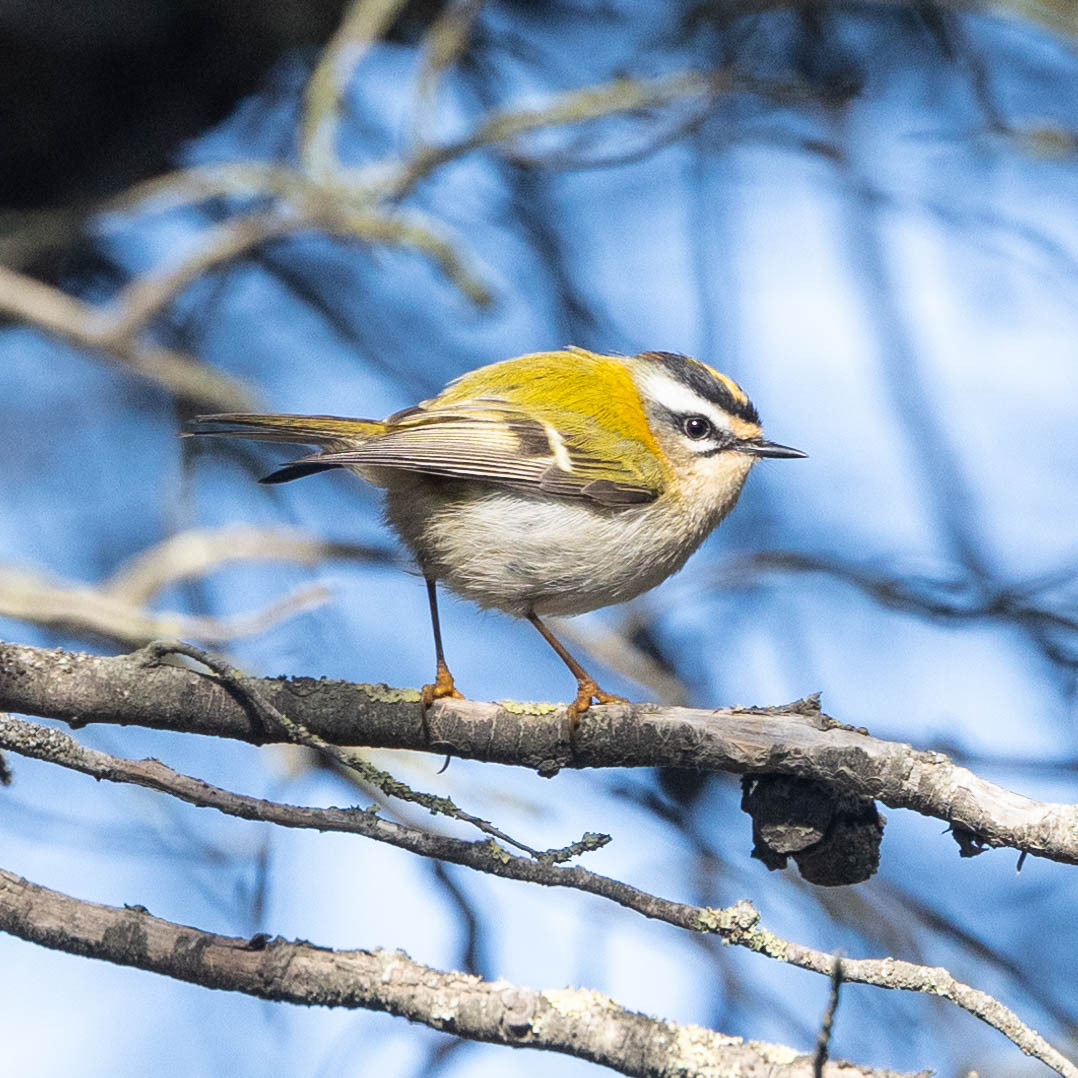
Regulus ignicapilla
Identity and names
The Common Firecrest, Regulus ignicapilla, is a tiny passerine in the kinglet family Regulidae. French calls it Roitelet triple-bandeau; Arabic names include “red-crested kinglet” and, in Moroccan references, “three-striped kinglet”. At about 9 cm long, with a wingspan around 14–15 cm and a mass near 5–6 g, it is much smaller than a sparrow. Its scientific name appears as Regulus ignicapillus in some guides, but current AviList uses ignicapilla. The similar Goldcrest is a separate species.
Identification
The most useful feature is the face: a strong white eyebrow above a dark eye stripe. This contrasts with the relatively plain-faced Goldcrest. Olive upperparts, pale underparts, two white wing bars and bronze-toned shoulder patches complete the adult pattern. The male’s crown has an orange centre, while the female’s is yellow, both framed by dark feathers. A crown colour glimpsed through foliage is less dependable than a clear facial view, particularly with changing light. Avoid identifying every tiny yellow-crested bird as Firecrest without checking the eyebrow.
Habitat, food and behaviour
It works through conifers, mixed woods, shrubs and sheltered leafy cover, taking very small invertebrates. Spiders and insect eggs are among its prey. Rather than relying on large seeds, it searches vegetation with a fine bill, moving quickly between twigs. In autumn and winter it may accompany other small woodland birds. This makes a moving feeding flock worth watching patiently from outside the vegetation. Shelter and prey-bearing foliage matter together: an apparently untidy wooded margin can provide useful feeding space that a closely cleared edge lacks.
Range and Arab occurrence
The species breeds across much of Europe and extends into northwestern Africa. The form balearicus occurs in the Balearic Islands and North Africa from Morocco to northern Tunisia, including Algeria. Morocco’s national checklist identifies both resident breeding and winter visitors, so its November presence there need not signify a recent arrival. Lebanon presents a very different picture: the 2026 national guide classifies it as a vagrant, citing historical records near Bcharre and above Yammouneh. These scarce Lebanese records do not establish a regular winter population, nor should Lebanese rarity be projected onto Maghreb breeding areas.
Breeding and development
A finely built cup nest is placed among branches or climbing vegetation, using materials such as moss, lichens and feathers. BTO reports a typical clutch of 7–10 eggs, female incubation of 14–16 days and fledging at about 19–20 days after hatching; two broods are typical in its reference account. These are developmental guides, not a fixed timetable for every North African forest. Young birds initially depend on adults for food. Inspecting or separating vegetation to reveal a nest can remove shelter and expose a small brood to disturbance.
November and responsible observation
November observation is best organized around suitable habitat and the country’s actual status. In Moroccan woodland, quietly following a mixed flock may reveal a resident or wintering Firecrest. In Lebanon, any suspected bird deserves careful documentation because it is exceptional: record the white eyebrow, dark eye stripe, location and date, ideally with photographs that do not require pursuit. A November record from the past is not a promise of annual occurrence. Stay on paths, avoid repeated call playback and never force birds into the open for an identification photograph.
Conservation
AviList 2026 records the global IUCN category as Least Concern. Local scarcity and habitat quality still matter, and this category is not a hunting authorization. Conserving connected woodland, varied shrubs and insect-rich foliage supports the bird’s feeding requirements. The Lebanese guide mentions illegal hunting and climate change among threats. Avoid unnecessary pesticide use and repeated disturbance, particularly during cold weather. Conservation is served better by a reliably documented sighting and an undisturbed bird than by a closer image obtained at the cost of its feeding time.
References
AviList Core Team — The Global Avian Checklist, v2026; British Trust for Ornithology — BirdFacts: Firecrest; The Wildlife Trusts — Firecrest; SongBird Survival — Firecrest; UNDP / ABCL / Ministry of Environment — Birds of Lebanon, second edition, 2026, p. 335; Bergier et al. — Liste des oiseaux du Maroc, 2017; Avibase — Common Firecrest.
Photo: Paulo Caseirito