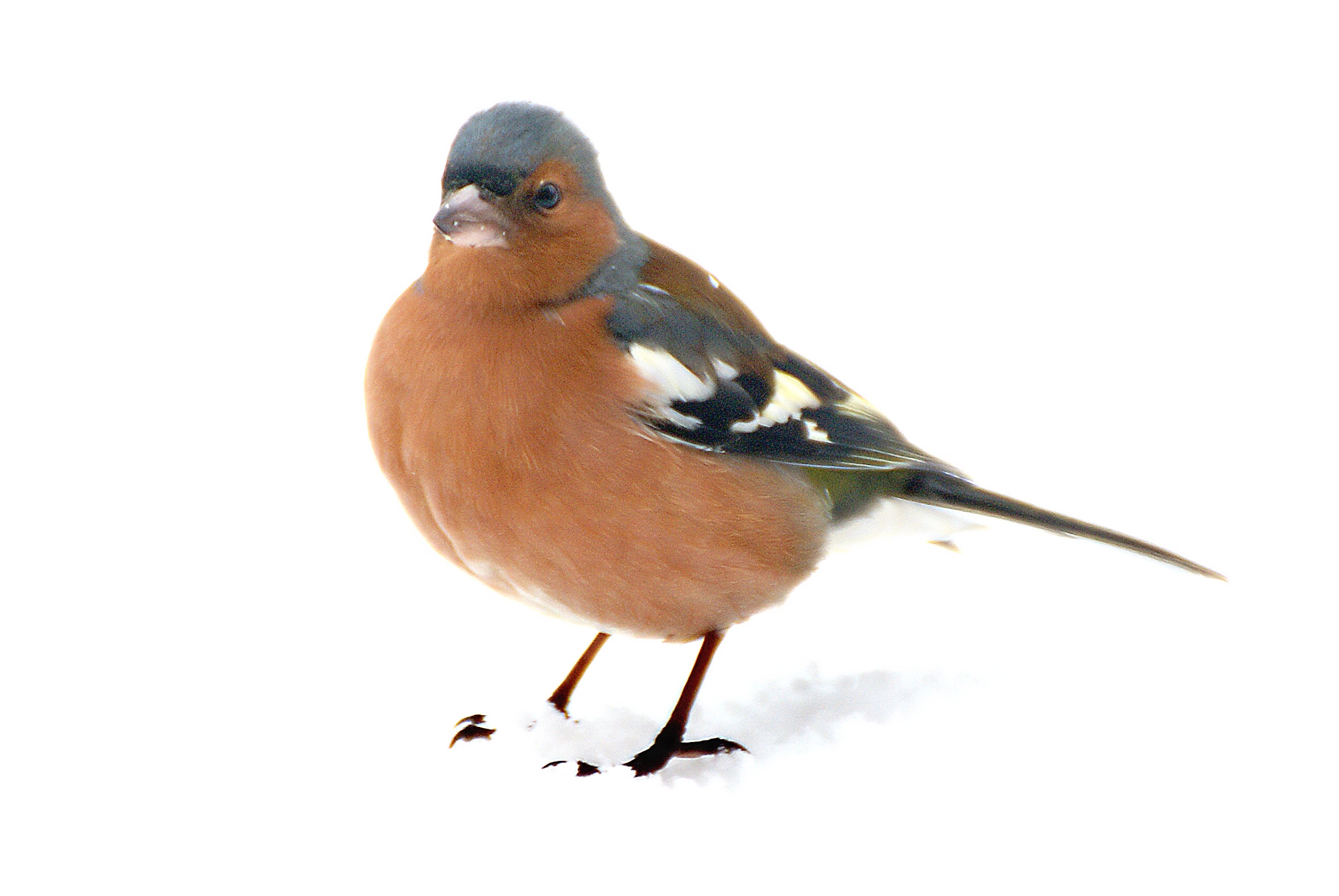
Fringilla coelebs — Identification, habitats, breeding and occurrence in the Arab region
Identity and taxonomy
The Eurasian Chaffinch, Fringilla coelebs, also called Common Chaffinch, is a finch approximately 15 cm long. This account follows the modern restricted species concept. African Chaffinch, Fringilla spodiogenys, resident and breeding in the Maghreb, is separate, as are the Atlantic-island species formerly grouped with it.
Identification
Males have a blue-grey head, pink-brown face and underparts, warm brown back and olive-green rump. Females are quieter grey-brown birds, and juveniles resemble them. Both sexes show conspicuous white wing markings and white outer tail feathers. The conical bill is shorter and stronger than that of a specialist insect-eater. Brambling has a white rump and stronger orange on the shoulders and breast. Separating Eurasian and African Chaffinches, particularly females and incompletely coloured birds, requires a combination of plumage, locality and vocal evidence rather than one isolated feature.
Habitat, food and behaviour
Breeding habitat includes broadleaved and coniferous woodland, orchards and tree-rich gardens. In winter the species also uses farmland, verges and open ground close to shelter. It eats seeds and invertebrates; insects and larvae become especially important when feeding chicks. Much feeding takes place on the ground, sometimes in mixed flocks with Bramblings and other species. Short, clear calls accompany a repeated song phrase ending in a distinctive flourish. Males defend breeding territories, whereas behaviour becomes more social outside the season.
Breeding and life cycle
The female constructs a compact cup in a tree or shrub from fine vegetation, fibres and moss, sometimes camouflaging it with lichens. A typical clutch contains 4–5 eggs, incubated by the female for approximately 12–13 days. Both parents provide food, and chicks leave the nest after about a fortnight. Timing varies with place and altitude: documented breeding in Lebanon extends from mid-March to late July. Adequate insect food and protected nest sites matter even for a bird associated with winter seed feeding.
Arab distribution and seasons
Some southern populations are resident while northern and eastern populations move south and west in autumn. Lebanon supports common resident breeders, joined by passage and winter birds from early October to late April, especially in woodland and orchards. Northern Iraq has limited breeding as well as winter occurrence. Jordan’s Dibbeen woodland supports wintering chaffinches; Egypt also receives winter visitors. Breeding chaffinches in Morocco, Algeria, Tunisia and much of the Libyan Maghreb belong to the separate African Chaffinch, not automatically to this species. Published records from Qatar and the United Arab Emirates show rare occurrence, a very different situation from Lebanon. Overlap among chaffinch species during the cold season makes careful identification valuable.
Ecology and conservation
Seed and invertebrate consumption connect the species to food webs in which it also feeds natural predators. Conservation references list Least Concern, although older assessments need their taxonomic scope checked. British declines have been associated with trichomonosis and other factors; the same explanation should not be assumed for every Arab population change. Maintaining trees, hedges and varied food resources, while reducing pesticide pressure, supports its habitats.
References
Cornell Lab — eBird taxonomy update 2023
BTO — BirdFacts: Chaffinch
Naturalis — Bird Remains Identification System: Fringilla coelebs
Ramadan-Jaradi and colleagues — Updated checklist of the birds of Lebanon, 2020
OSME — Region List 10.2, passerines
State of Jordan’s Birds — Dibbeen account
IUCN Red List — Fringilla coelebs, 2018 assessment
Photo: Bernard Spragg. NZ — CC0 1.0.