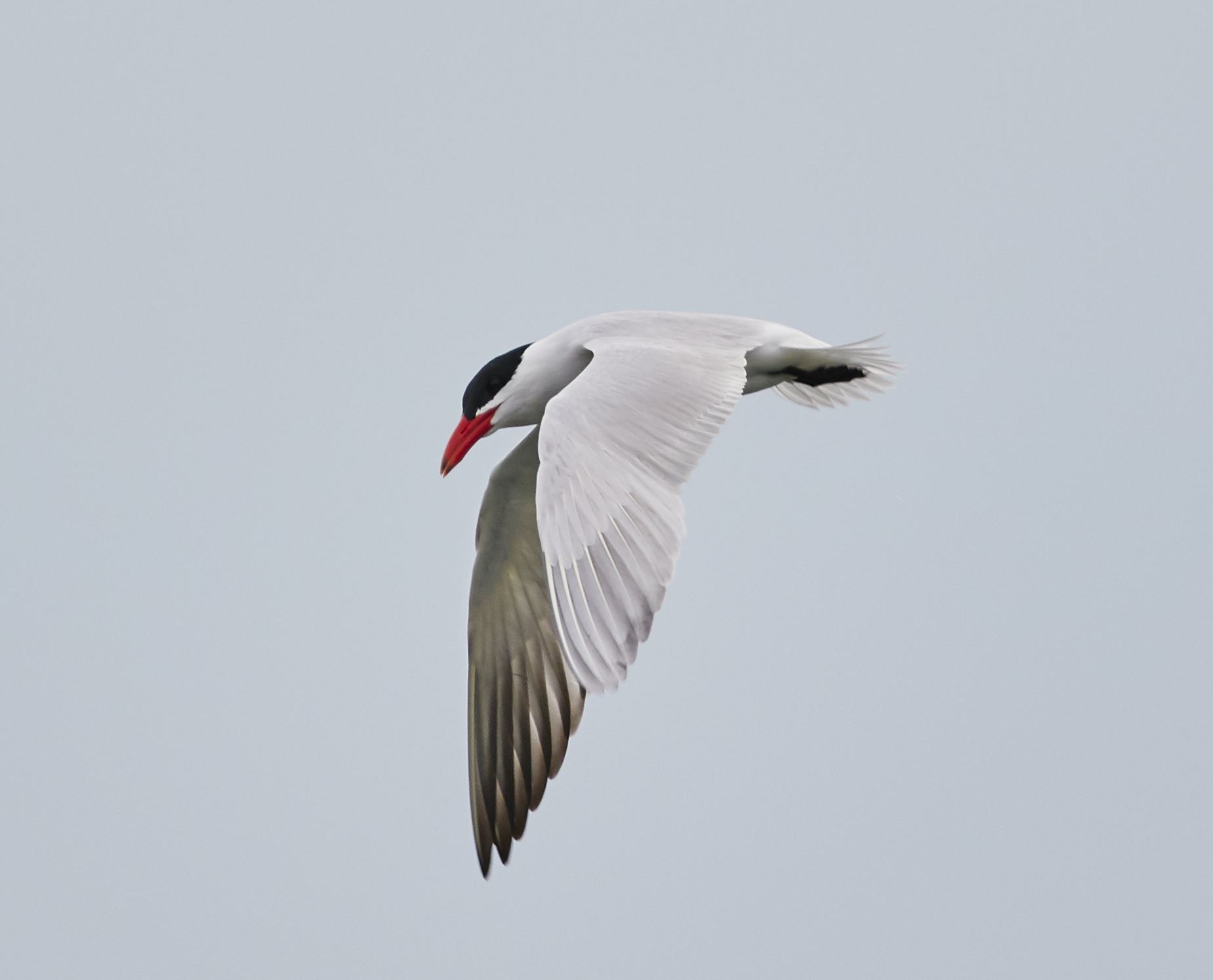
Hydroprogne caspia
Identity and identification
Caspian Tern Hydroprogne caspia belongs to Laridae; its older name is Sterna caspia. The largest tern has a massive red bill, robust body and shallowly forked tail. The breeding cap is black, becoming mixed with white outside that season.
Habitat and food
It searches coastal water, lakes and estuaries for fish, then dives to capture them. Open shores and islands provide resting sites. Populations differ in being resident or migratory.
Breeding and development
The nest is a simple ground scrape. Animal Diversity Web gives one to three eggs, shared incubation of 25–28 days and fledging around 37 days after hatching. Young still depend on feeding after flight; northern breeding dates should not be transferred to the Gulf.
Arab occurrence and seasonality
Qatar’s current list classifies it as a common resident breeder and winter visitor, recorded in all months. November can therefore combine resident presence with winter additions. This does not make every bird a migrant or establish nesting during that month, and Qatar’s status cannot be assigned to other Arab countries.
Observation and conservation
Healthy fishing areas and quiet resting and nesting sites are necessary. Distant observation avoids exposing eggs and chicks when parents are disturbed.
University of Michigan — Animal Diversity Web: Caspian Tern · British Trust for Ornithology — BirdFacts: Caspian Tern · Qatar Bird Observation Group — Qatar Bird List · AviList Core Team — Global Avian Checklist v2026, 20 October 2026
Species illustration: David Bird — CC0 1.0. · 1 · https://creativecommons.org/publicdomain/zero/1.0/