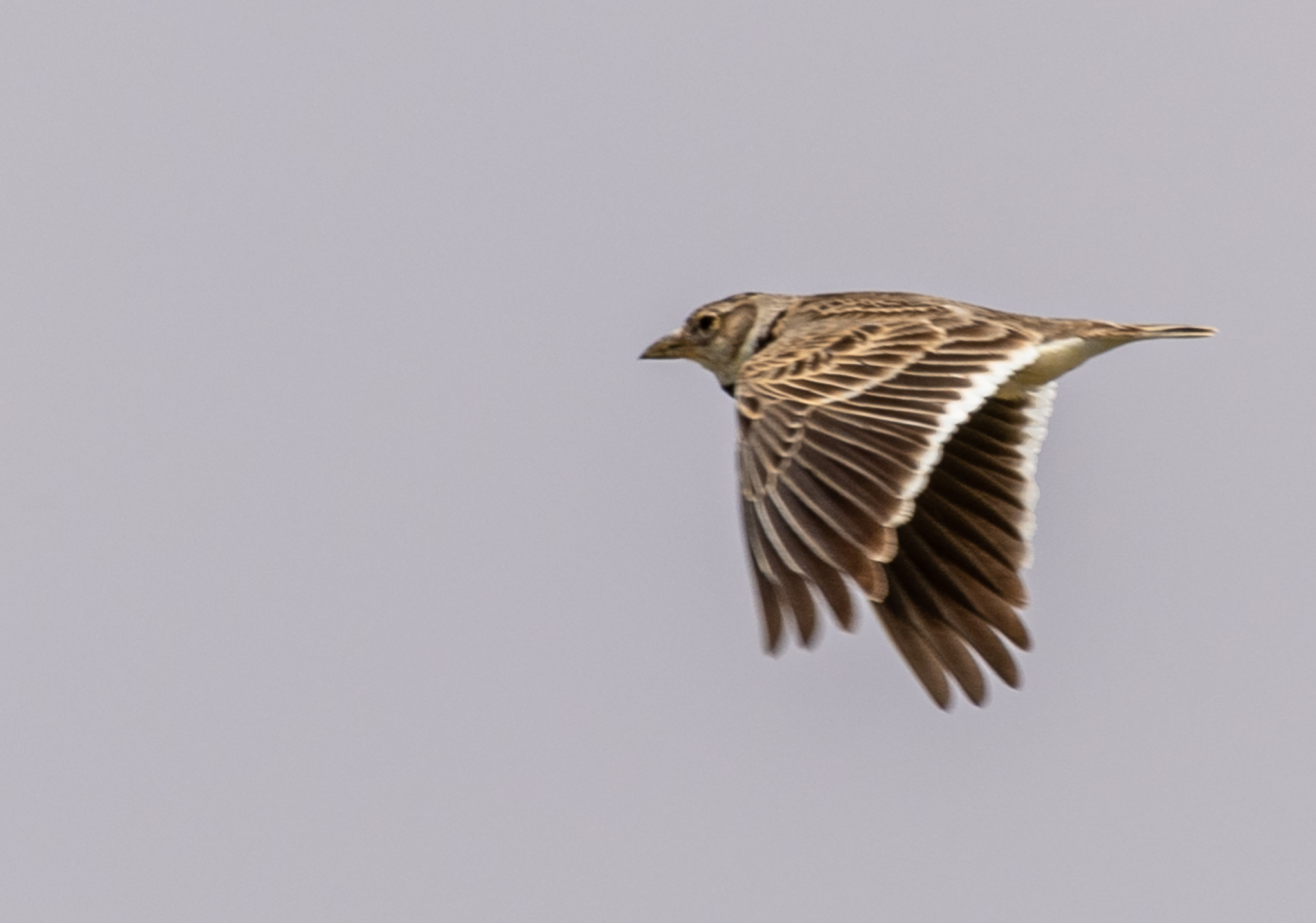
Melanocorypha calandra
A large lark concealed in the fields
The Calandra Lark, Melanocorypha calandra, is a bird of agricultural plains and grassy steppes, not a woodland species despite its elaborate song. A member of the lark family, it measures about 18–20 centimetres. Its body is substantial and its bill strongly conical, while the streaked brown upperparts resemble soil and dry grass stems. A field can consequently appear empty until several birds move together. Vernacular names shared between different larks are not, by themselves, sufficient evidence for identification.
Adults have two conspicuous black patches at the sides of the lower neck. The dark underwings are bordered by a striking white trailing edge in flight. Reliable identification combines these marks with bill shape and build rather than relying on breast colour or a local name. The sexes look similar. Young birds can have very weak or absent black patches, together with pale edges to back and wing feathers. Weak neck markings alone do not establish that a bird is female.
Separating similar larks
The Bimaculated Lark, Melanocorypha bimaculata, also has a heavy bill and paired black neck patches. Calandra, however, shows a strong contrast between its dark underwing and white trailing edge, as well as white on the outermost tail feathers. Bimaculated lacks that broad trailing band, and its shorter-looking tail shows white tips rather than the same pattern. A bird seen only standing and facing the observer may remain unidentified, especially at distance or in harsh light.
Eurasian Skylark has a smaller bill and a less substantial build, without the same large paired neck patches. Crested Lark draws attention to its pointed crest and longer bill. Record relative size, bill shape and the wing and tail patterns when birds take off naturally. Chasing a flock to obtain one additional feature is unnecessary: waiting at a field edge often provides a better view while allowing the birds to continue feeding.
Habitat, food and daily activity
Calandra Larks favour extensive open areas with grassy vegetation, including steppe, rain-fed cereal fields and pasture. Land being undeveloped does not automatically make it suitable: dense trees or tall scrub change its character. An open field can combine ground for walking and searching for food, vegetation that conceals a nest, and shorter patches from which birds can detect danger. The value of these elements changes with the season and the way the land is managed.
Food is collected on the ground, with invertebrates becoming particularly important during breeding and chick rearing. In autumn and winter the birds eat seeds and other plant material, including grass leaves and shoots. This seasonal shift explains the importance of crop residues and grassy margins, not merely the grain crop itself. Removing all wild plants and using pesticides intensively can reduce both animal and plant foods. A flock moving among fields depends on a network of habitats rather than one patch that happens to be good on a particular day.
Song, pairing and nest construction
The male rises in song above the breeding ground, delivering varied phrases that can include imitations of other birds. This display is more than an attractive performance: it contributes to territorial advertisement and communication during pairing. Breeding pairs occupy territories, which may be close together where suitable habitat is concentrated. A winter gathering does not mean that a colony of nests will occupy the same place.
European references place breeding mainly between spring and early summer, with timing varying geographically. A Spanish calendar cannot be treated as a fixed schedule for Morocco or Iraq. The nest sits in a small hollow on the ground, sheltered by low vegetation, and its cup is made from stems, grasses and lighter material. The female takes the main role in construction and incubation. Surrounding cover remains important for safety, so opening a route towards a nest can expose its position even without touching it.
From eggs to independent birds
The Spanish vertebrate encyclopaedia compiles a clutch range of three to six eggs, most often four or five. It gives incubation as generally 11–13 days, sometimes extending to 16 days. These are reference ranges rather than a guaranteed timetable for every nest. Their variation illustrates why the species' life history should not be reduced to one unattributed number, or a hatching date calculated from seeing a sitting bird without knowing when laying began.
According to the same reference, chicks remain in the nest for about eight to ten days, then leave while still requiring care. Nest departure does not mean independence or proficient flight. Both parents help feed them, and a failed breeding attempt may be followed by another. After breeding, gatherings and movements become more conspicuous. Protecting a breeding site must include chicks hidden near the nest, not just eggs: cultivation or vehicles can injure young birds invisible to a passer-by.
Arab distribution and the November scene
The range extends from western Europe and northwestern Africa into western and central Asia. In Morocco, Algeria and Tunisia the species is a resident breeder of suitable plains, while the wider range includes partly migratory populations. Winter movements reach parts of the Mediterranean basin. Consequently, not every individual in an autumn flock need have originated locally, and a photograph alone cannot reveal the country where it hatched.
Iraq, Syria and western Jordan lie within its regional Levantine and Middle Eastern range, with differences among habitats and populations. AviList identifies Mediterranean Egypt and Jordan as winter destinations for migrants, alongside Iran outside the Arab world. This does not imply uniform occurrence throughout those countries. In November, open farmland and steppe are useful places to follow gatherings, recording dates, numbers and habitat rather than describing the bird as present everywhere.
The Gulf presents a different situation. The Kuwaiti reference describes it as a vagrant, and the regional review documents limited records in Kuwait, Bahrain and Qatar, including autumn and winter observations. The Saudi reference records its presence at sites in the kingdom without treating it as a common regular winter species. The arrival of a flock at a Gulf farm in one winter neither establishes a breeding habitat nor guarantees its return every year.
Conservation and responsible observation
AviList 2026 records Calandra Lark as globally Least Concern, LC, but a national assessment can be more worrying: Spain assesses its breeding population as Near Threatened. Different geographical scales do not constitute a contradiction. Agricultural intensification, conversion of steppe to orchards or tree plantations, and the removal of fallow land threaten the diversity of open habitats. Conservation does not always mean planting trees; steppe birds need functioning steppe.
Observe from established roads and edges without entering plots where nesting behaviour is evident. Keep dogs and vehicles away from ground cover, and avoid playback or repeatedly making birds fly. Repeated records within the same season help distinguish genuine change from differences in observation effort. Finally, a global conservation category does not grant permission to hunt: local legal frameworks are separate from extinction-risk classification.
Photo: karim Attouche / iNaturalist (CC0 1.0)