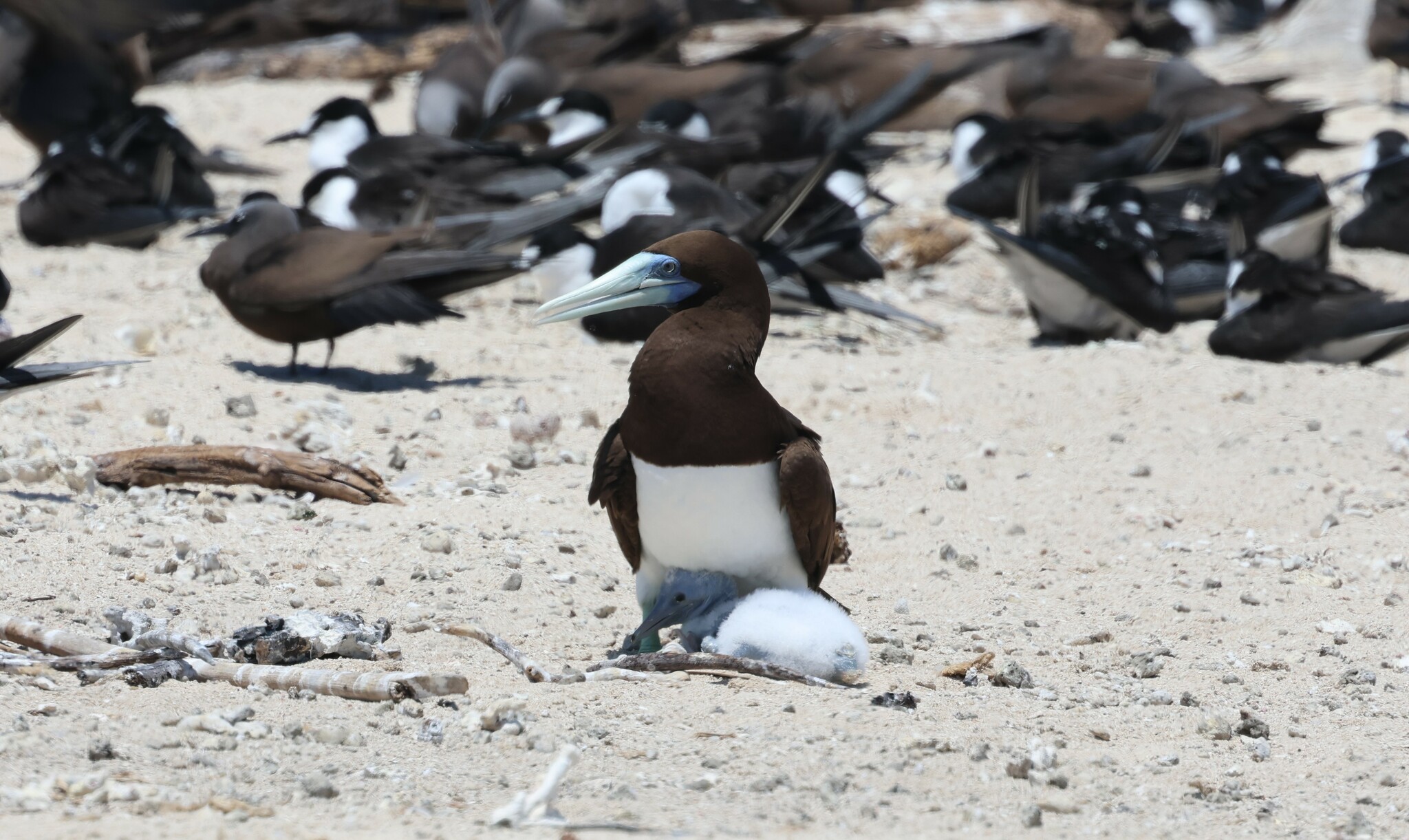
Sula leucogaster
A seabird hunter with a defined identity
The Brown Booby, Sula leucogaster, belongs to the booby and gannet family, Sulidae. A strong-flying seabird, it is associated in the Arab world with the Red Sea, Gulf of Aden, and the islands and warm waters of the Indian Ocean. It is not entirely brown: the adult’s brown head, neck, upper breast and back contrast with a clear white area on the belly. Its bill is stout and pointed, the wings long, and the graduated tail tapered. This structure suits a bird that searches for fish from the air before plunging into the water.
The scope of its name has changed in modern taxonomy. AviList 2026 separates Cocos Booby, Sula brewsteri, from Brown Booby; eastern Pacific populations formerly included under the latter name now belong to a distinct species. Red Sea and Indian Ocean birds remain Brown Boobies within the subspecies plotus. An old photograph labelled “Brown Booby” therefore cannot automatically illustrate the species as currently recognised without checking its origin and identity. A name in an older book may cover a broader group than the same name does today.
Adults, juveniles and similar species
In adults, the boundary between the brown breast and white belly appears relatively sharp. Juveniles are browner below and may show mottling, so the same contrast is not apparent. Bill, wing and tail shape remain important identification features. Females are larger on average than males, but judging sex from size alone in a single distant bird is unreliable. Bare-part colours also vary with sex, condition and age; the colour of one foot or a small facial patch cannot replace assessment of the whole bird.
Masked Booby deserves comparison in the Arabian Sea. Its adult plumage is extensively white, with dark parts on the wings and face, unlike the dark-headed and dark-chested adult Brown Booby. Comparison becomes more difficult with brown juveniles. A clear view of the underside, head and pattern of contrast between neck and belly then helps. A brief encounter from a moving boat should not become a confident species record if the necessary features were not visible. It is reasonable to retain it as an unidentified booby until better evidence becomes available.
Finding and catching food
Brown Booby feeds on fish and squid, searching coastal waters and areas around islands, and sometimes ranging into more open water. It watches the surface and plunges head first at an angle towards prey, adjusting its flight or hovering before a dive. Alternating flapping and gliding allows it to cover broad areas rather than remain tied to one patch of water. A bird returning without a visible fish in its bill has not necessarily failed to catch food: a meal for its chick may be carried internally and delivered by regurgitation.
It may feed alone or near other birds when prey gathers, and rests on islands, rocks or suitable offshore structures. Its need for fish connects conditions at sea with nesting success. A quiet colony alone is insufficient if food becomes distant or unavailable. Nor does a bird beside a boat necessarily behave tamely or need feeding. Maintaining a steady distance makes it possible to observe searching, diving and return to a resting place without changing the bird’s behaviour.
Nests, incubation and chick care
The bird selects a ground site on a rocky or sandy island, sometimes nesting on a rock ledge or in a depression with little construction. The amount of vegetation and natural debris gathered varies between places; a nest does not need to be large to be active. Both members of the pair share incubation and care. References usually mention one or two eggs, with three occasionally reported, and incubation of roughly six weeks. The Saudi Arabic reference gives approximately 43 days.
Often only one chick reaches flying age even when two eggs hatch. Egg numbers therefore do not equal the number of young that will leave the colony. A chick grows at the site, developing white down before full feathering, and requires a continuous food supply. The Saudi reference places first flight at about 85–105 days, while wider references give a broader range influenced by conditions. Feeding continues after flight for weeks or months. Leaving the ground does not mean that a juvenile can immediately meet all its own needs.
Its presence in Arab countries
The 2003 PERSGA report documents breeding in Saudi Arabia, Egypt, Sudan, Yemen, Djibouti and Somalia. Yemen’s Socotra archipelago is also within the breeding range described by the modern global taxonomy. The regional connection is thus not based on a single wandering bird. It does not, however, imply an even distribution across every shore or island. Nor can the old report’s figures serve as a current census: survey coverage, timing and the method of counting nests all influence the results.
Saudi studies offer a more detailed picture. Research published in 2014 documented nesting on islands in the northern Red Sea. Another paper, published in 2025, dealt with surveys conducted in 2011–2013 and established additional colonies in the Al Wajh and Al Qunfudhah sectors. Its publication date does not turn those nests into field discoveries made in 2025. In Oman, the Oman birds database describes the species as an uncommon offshore visitor. It should not be promoted to a local breeder merely because it nests in nearby Yemen, or because another booby species breeds on Omani islands.
A long season without one universal calendar
Nesting dates vary within the Red Sea itself. The Saudi survey paper published in 2025 describes chicks in the north during May, compared with nests containing eggs in the central sector during July in the survey years. It also cites Umm al Qamari studies recording nesting throughout the year and peaks in different months. A simple description as a summer visitor that inevitably leaves in autumn therefore does not fit the species. Some populations are resident, with individual movements changing according to breeding and food.
Adults and juveniles may continue to be seen in its Arab marine range in November, and care of late young may still be taking place at some sites. That general possibility does not establish that a nest on a particular island is active. The necessary evidence is behaviour watched from a distance: carrying food, feeding a chick or sustained attendance at a nest site, together with a recorded date. Repeated observation is more useful than turning one visit into a judgement about the season along an entire coast.
Threats and the value of undisturbed islands
Brown Booby faces pressures on both land and sea: nest disturbance, introduced animals, fishing debris, pollution and changing food resources. The Saudi study published in 2025 described adults leaving nests when people approached, exposing eggs to predation. This is a direct connection between a visit and an ecological consequence. Even someone who never touches an egg or chick can damage a nest’s prospects by forcing a parent to leave at a critical moment.
An older global conservation assessment that included Cocos Booby should not automatically be transferred to the species after the taxonomic split. The practical priority is to protect known colonies and measure breeding success and threats at each site. Observation should remain outside the colony, without chasing birds with boats or drones or feeding them for photographs. An individual entangled in fishing equipment should be reported to a qualified rescue organisation rather than pulled from a distance or handled in ways that endanger bird and people. Safe islands and healthy seas are both necessary for this distinctive marine diver to persist.
Photo: Don Wellmann / iNaturalist (CC0 1.0)