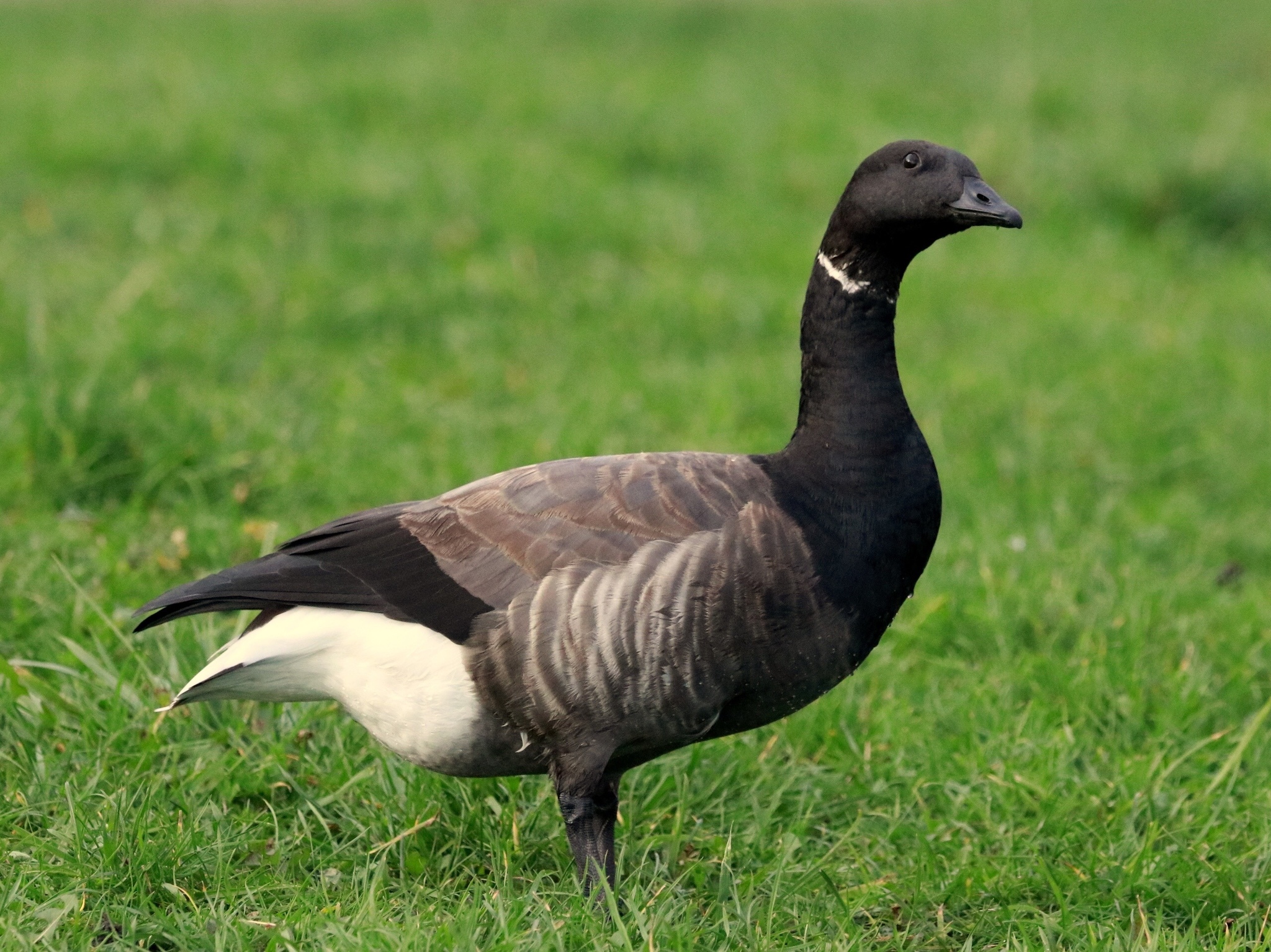
Branta bernicla
A small, dark coastal goose
Brent Goose Branta bernicla is a compact goose only a little larger than a Mallard, with a short black bill, black legs and a dark head, neck and breast. Adults have white patches on the sides of the neck and conspicuous white beneath the tail. The back is grey-brown, while the belly varies markedly between populations. Males and females are alike in plumage, so belly shade is not a way of identifying sex.
Juveniles lack the adult neck patches at first and have a more patterned, pale-edged upperwing and back. Barnacle Goose is a useful comparison: its extensive white face differs from Brent's dark head. A distant Red-breasted Goose can also look unexpectedly dark when its chestnut colour is invisible. Check head and neck markings, body proportions and the whole plumage rather than relying on darkness alone. Brent flocks often fly in irregular lines or loose masses, accompanied by low, gruff calls.
Forms and a circumpolar distribution
The main familiar forms are Dark-bellied Brent, Pale-bellied Brent and Black Brant. Dark-bellied birds breed in Arctic Russia and winter mainly along western European coasts. Pale-bellied populations breed in parts of Arctic Canada, Greenland, Svalbard and Franz Josef Land, with different groups using different wintering routes. Black Brant occupy the eastern Siberian and North American Arctic sector and are closely associated with the Pacific coast outside breeding.
These names describe geographic plumage groups, not seasonal changes in one bird. In Europe, Dark-bellied birds have a darker underside than Pale-bellied birds, while Black Brant typically show a strong white neck pattern and contrasting flanks. Taxonomic treatments vary in detail, so a record should describe the observed features even where a subspecies cannot be assigned confidently. North-western Europe is a principal wintering region; Arab shores lie at the margins of the usual range.
Eelgrass, algae and tidal feeding
Brent Geese are unusually coastal among geese. Estuaries, lagoons, shallow bays, mudflats and saltmarshes provide feeding and resting habitat. Eelgrass, marine algae including sea lettuce, and saltmarsh plants are important foods. Some populations also graze grassland or agricultural fields. Feeding may involve reaching down from the surface, tipping up in shallow water or grazing vegetation exposed by the falling tide.
The availability of underwater meadows links their daily routine to water levels. California's wildlife account describes feeding particularly when eelgrass and algae become accessible at low tide, and resting in flocks on open estuarine water. It also notes that a developed salt gland permits drinking seawater. In the Arctic breeding season, terrestrial plants become more important; the Norwegian Polar Institute records scurvy-grass and mosses among foods taken in Svalbard.
Breeding in the short Arctic summer
Brent Geese nest on tundra, often near ponds, on islands or in low coastal terrain, as separate pairs or loose colonies. The nest is a shallow depression lined with plant material and down. In Svalbard, egg laying usually occurs in mid-June after arrival around late May or early June. These dates describe that population, not a worldwide schedule.
A usual clutch contains 3–5 eggs. The female incubates, with the male nearby; BTO gives 24–26 days. Young leave the nest soon after hatching and are tended by both parents. The Norwegian Polar Institute describes fledging after about six weeks. Family groups remain together through winter into the following spring, and birds generally begin breeding at two or three years. Adults become temporarily flightless during wing moult, making undisturbed refuges particularly valuable.
Morocco: documented exceptional visitors
Moroccan records illustrate how far south individual Brent Geese can travel without establishing a regular wintering population. The Moroccan Rare Birds Committee's first report accepted a Dark-bellied Brent photographed at Khnifiss lagoon on 3–4 May 1994. This late-spring occurrence is a specific record, not evidence of breeding or of a predictable annual passage there.
Its report for 2007 accepted a first-winter Pale-bellied bird at Salé beach on 23–30 November 2006, identifying it as Morocco's first record of that form. The report treated the species as an accidental visitor. Together these cases show both temporal and plumage diversity among rare Moroccan occurrences. The earlier committee report also cites a historical observation at Baie de l'Étoile in northern Mauritania, without assigning a subspecies.
Other Arab records and their limits
CMS lists Algeria and Tunisia as countries of vagrant occurrence. This places the species on their record lists, but does not establish regular coastal wintering. Egypt requires an additional historical distinction: the EORC checklist published in 2019 places Brent Goose in Category B, meaning wild records before 1950 but none thereafter accepted in that checklist. It should therefore not be presented from that evidence as a routine contemporary Egyptian winter visitor.
These scattered records contrast with the large, established winter concentrations in north-western Europe. Suitable-looking estuaries around the Mediterranean do not by themselves demonstrate use by Brent Geese. At an unexpected Arab locality, photographs showing the neck, belly and upperwing can help establish both identity and age, while repeated sightings should be checked for the possibility that they concern the same individual.
Conservation from sea meadows to tundra
CMS and BTO give the global category as Least Concern. That does not mean all populations or sites are secure. Dependence on concentrated coastal feeding areas makes local habitat loss, recreational disturbance and changes in food supply important. The Norwegian Polar Institute links historical declines partly to loss of eelgrass on wintering grounds and intensive collection of eggs and down in the breeding range.
Conservation connects both ends of the journey: tundra nesting habitat, coastal stopovers and productive winter bays. Observers should avoid flushing feeding flocks, keep dogs away and leave space at high-tide resting sites. Counts that distinguish adults from juveniles can help reveal breeding success, especially when repeated consistently across years.
RSPB: Brent Goose · Norwegian Polar Institute: Brent Goose · BTO BirdFacts: Brent Goose · California Department of Fish and Wildlife: Brant ecology · Moroccan Rare Birds Committee: report 1 · Moroccan Rare Birds Committee: report 13 · CMS: Brent Goose status and occurrence · EORC: Checklist of the Birds of Egypt, 2019
Photo: Лариса Артемьева