A white-rumped winter visitor linking northern forests with the Levant and Morocco
Identity and recognition
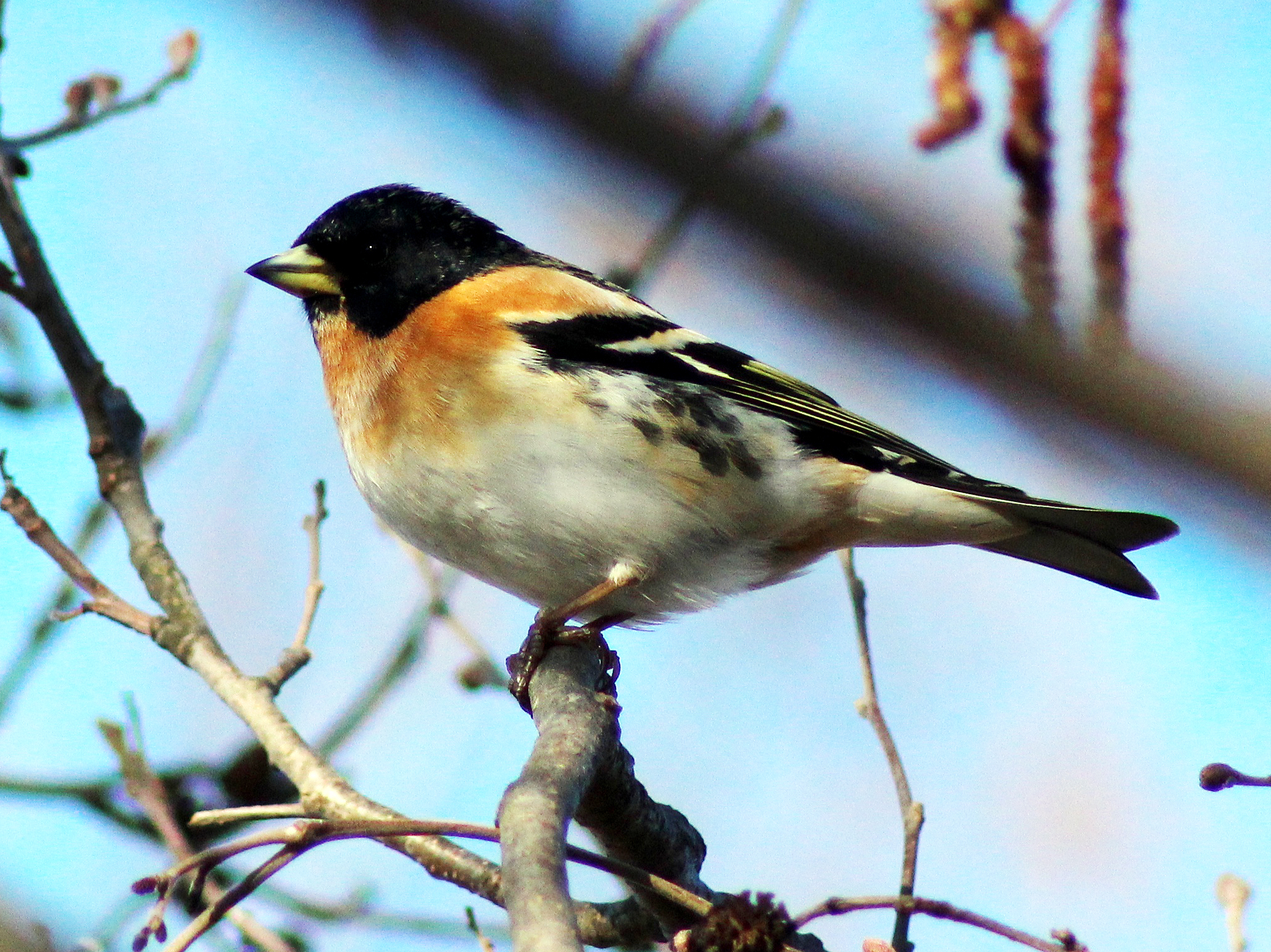
The Brambling Fringilla montifringilla belongs to the finch family Fringillidae. The Lebanese guide also records the names «صليج الشمال» and «دريك الصلنج». Orange shoulders and breast, a white belly and a conspicuous white rump form its main field pattern. The breeding male has a black head and back, partly obscured by pale feather edges in winter. Females have a quieter grey-brown head and subdued orange breast. Young birds resemble the female more than the striking summer male, making wing and rump markings particularly useful.
Distinguishing similar birds
Bramblings often share flocks with Chaffinches. The clean white rump is their clearest distinction, supported by the orange shoulders and breast and the transition to the white belly. Chaffinches lack this white rump. Bill colour also changes: breeding males have a dark bill, whereas a yellowish bill with a dark tip is usual outside breeding. Watching a flock both in flight and on the ground reveals features that may be hidden in a single frontal photograph.
Habitat, food and behaviour
Breeding habitats extend across northern Eurasian woodland, including birch stands and mixed coniferous forest. In winter the species uses woodland edges, farmland and orchards with accessible seed. Beech mast is an important food in European wintering areas; other seeds and invertebrates also feature, particularly in the breeding season. Birds frequently feed on the ground and associate with other finches. Variable seed crops help explain why winter abundance can differ markedly between years.
Breeding and annual cycle
The cup-shaped nest occupies a tree fork, for example in birch or spruce, and incorporates grasses, moss and other plant material with a finer lining. Females normally lay five to seven eggs and perform incubation. BTO summarises typical incubation as 11–12 days and the nestling period as 13–14 days. These are breeding-cycle figures from the northern range; winter visits to Arab countries represent a different part of the annual cycle.
Arab-region distribution and seasonality
Arab-region occurrence is principally associated with the colder months. The Lebanese guide records regular but uncommon passage and winter presence from early October to late April in cedar, pine and fir woods and orchards. Jordan lists it as a winter visitor. Morocco’s 2017 checklist also classifies it as wintering. Kuwait’s checklist, updated in September 2026, calls it a rare winter visitor. A Levantine autumn flock therefore has a different regional context from a rare Gulf record; the scale of arrivals varies between places and years.
Ecology and conservation
Seed and invertebrate consumption connect this finch to woodland food webs, while migration links northern breeding forests with southern winter habitats. Its global category is Least Concern, a measure of extinction risk rather than abundance in every country. Diverse woods, orchards and winter seed supplies support visiting birds. Recording flock size, habitat and date helps distinguish a productive winter from sustained local change. Observations are best made without repeatedly flushing feeding flocks.
References
BTO — BirdFacts: Brambling
Woodland Trust — Brambling
University of Michigan — Animal Diversity Web: Fringilla montifringilla
وزارة البيئة اللبنانية — دليل الصياد المصوّر
Jordan BirdWatch — Jordan Bird List
Bergier et al. — Liste des oiseaux du Maroc, révision 4.0, Go-South Bulletin 14, 2017
Kuwait Ornithological Rarities Committee — Kuwait Bird List, September 2026
Photo: Estormiz — CC0-1.0.