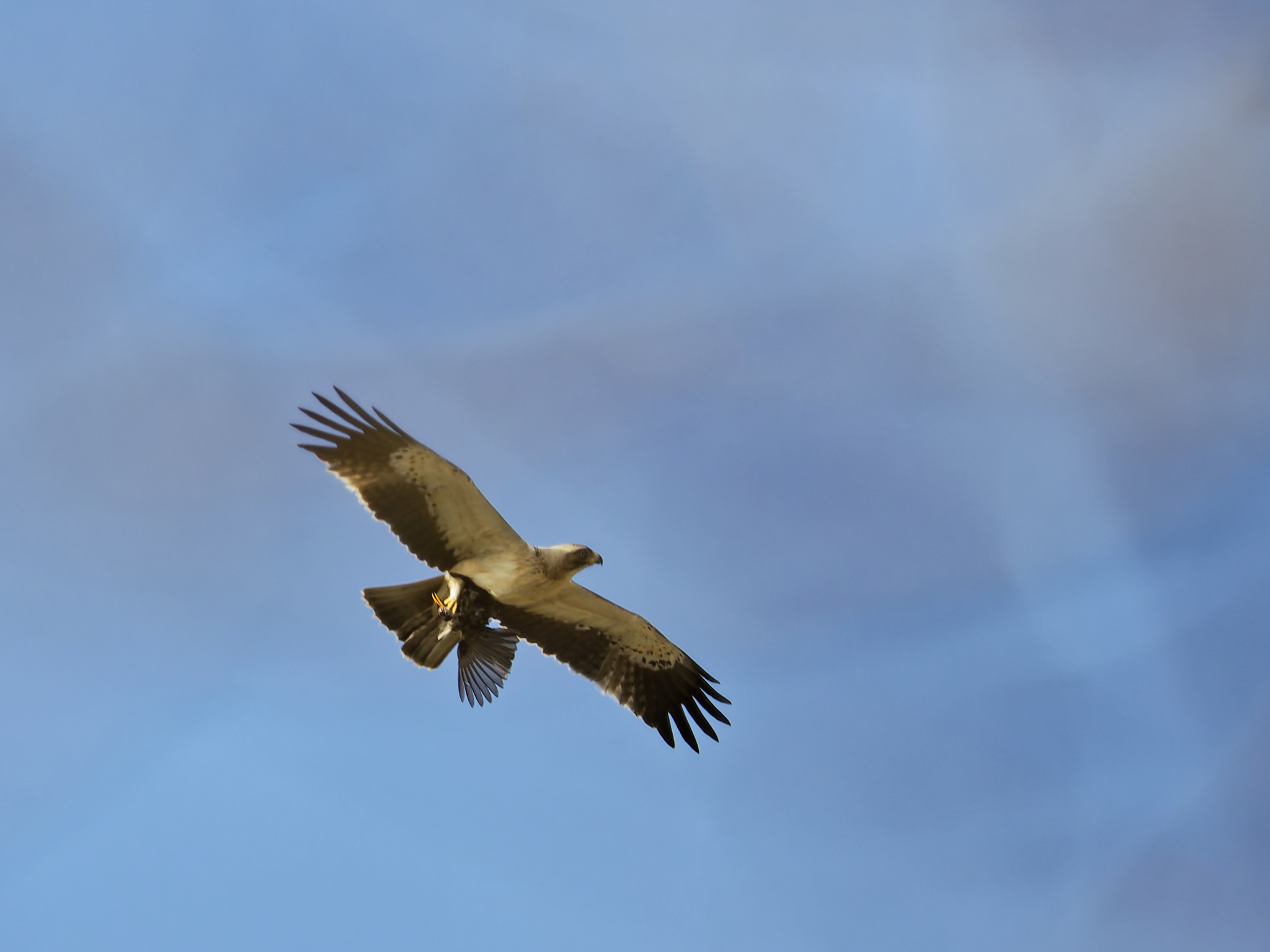
Hieraaetus pennatus
Identity and identification
Booted Eagle Hieraaetus pennatus belongs to Accipitridae. Pale and dark forms occur; pale birds show light body and wing coverts contrasting with dark flight feathers. Feathered legs explain the English name. Small size alone cannot separate it from buzzards. It is placed in the order Accipitriformes. The IUCN category carried in AviList 2026 is Least Concern (LC).
Habitat, food and behaviour
A mosaic of trees and open ground provides habitat. Birds, small mammals and reptiles form its prey, captured after searching from height or rapid attacks. Diet varies regionally. Tree nesting requires suitable hunting country nearby.
Breeding and parental care
It builds in a tree and usually lays two eggs. References give incubation around 37–40 days, principally by the female while the male supplies food, and first flight at about 50–55 days. Both contribute to care, with feeding dependence continuing after first flight.
Range and Arab occurrence
It breeds in parts of Europe, North Africa and western Asia, with populations migrating south. Lebanon has scarce irregular summer breeding and passage, without established regular modern winter occurrence. Older taxonomic combinations can refer to this same species.
Seasonality and observation
Lebanese spring passage occurs in March–April and autumn passage in August–October. November follows most usual local occurrence. Record colour form and wing and tail views without treating a dark individual as another species simply because of colour.
Ecological role and conservation
Loss of large trees, poison, persecution and electrical hazards are pressures. Protecting nests and woodland-open-country mosaics supports its life cycle. Exact nesting coordinates should not be publicly disclosed where this would increase disturbance or access.
References
Ramadan-Jaradi et al. — Updated checklist of the birds of Lebanon, Sandgrouse 42 (2020), 186–238.
University of Michigan Museum of Zoology — Animal Diversity Web: Hieraaetus pennatus.
AviList Core Team — AviList: The Global Avian Checklist, v2026 (20 October 2026).
Photo: Luis Ferreira — CC0 1.0.