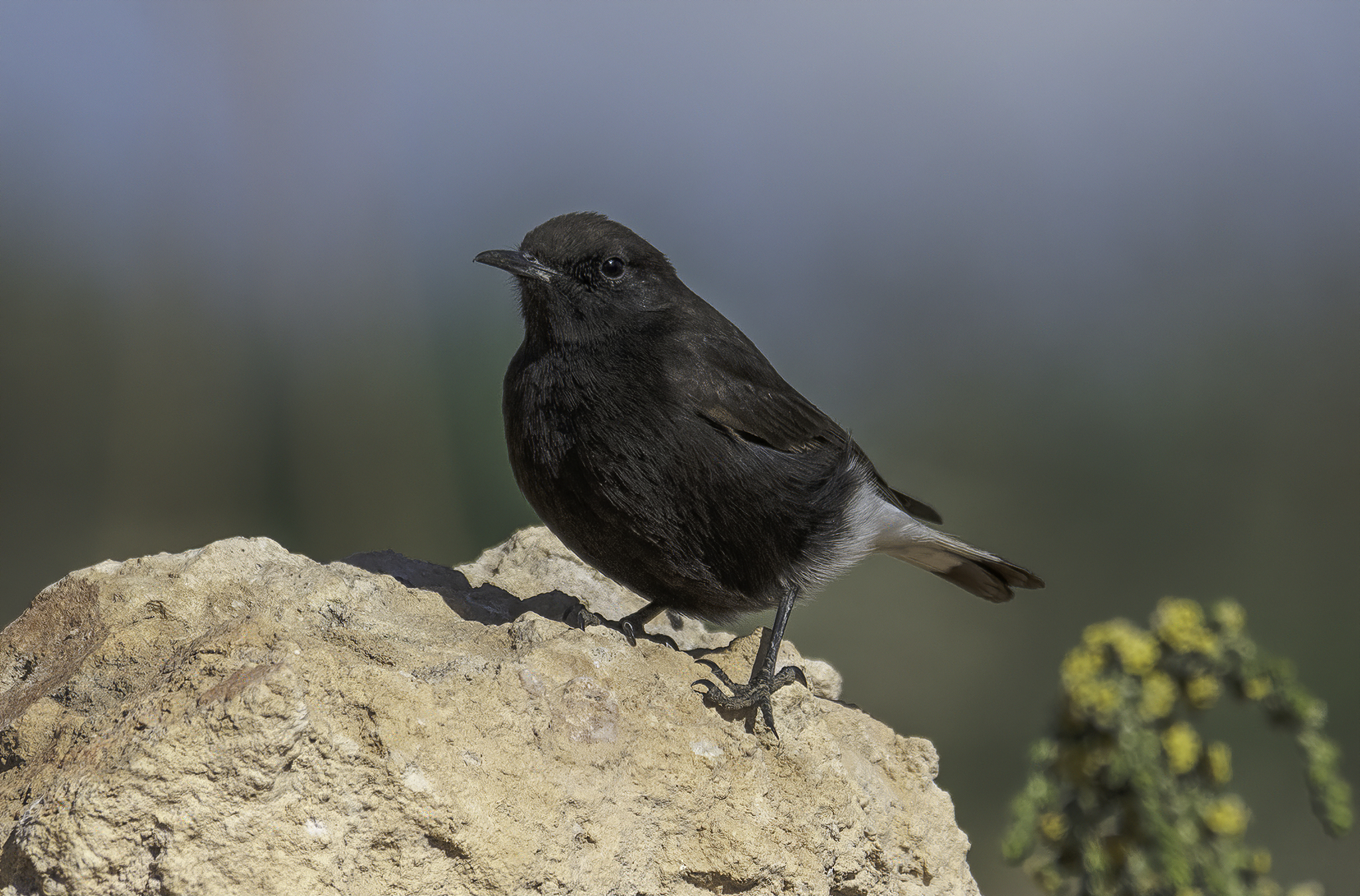
Oenanthe leucura
A rocky-country wheatear of the western Arab world
Black Wheatear, Oenanthe leucura, belongs to the flycatcher family Muscicapidae and measures about 18 cm. At a distance it can seem almost uniformly black, until movement over the rocks reveals the white rump and tail. Its Arab distribution is centred on northwestern Africa, unlike White-crowned Wheatear, whose desert range extends much farther east. Geographical context helps identification, but cannot replace examining the bird itself, particularly where the two species may occur together.
Its presence in November usually reflects local residency rather than a long seasonal passage. A pair may remain within its territory outside the breeding season, even if singing decreases or the birds use different parts of their habitat. Returning to the same slope on separate days may therefore reveal birds missed on a first visit. Silence is not absence, and a solitary bird is not proof of a migrant newly arrived from the European side of the Mediterranean.
Male, female and juvenile plumages
Males are very dark, appearing blacker and more lustrous in favourable light, while females tend towards dark brown. Juveniles broadly resemble females but look duller. White on the rump and much of the tail contrasts with black central feathers and a continuous black terminal band, together making an inverted T-like pattern. This becomes clear when the tail spreads and is more dependable than judging gloss from a shaded photograph.
A black-headed White-crowned Wheatear can look similar, but normally lacks the same uninterrupted terminal band and differs in the distribution of white and black below. The French name Traquet rieur refers to this same Black Wheatear, not another species. AviList v2026 places the African populations under the subspecies name riggenbachi. Older names occur in earlier guides; they should not be counted as separate species or additional birds in an inventory.
Arab countries and the limits of the range
The North African resident range includes Morocco, Algeria, Tunisia and parts of Libya. More specific Libyan regional accounts place it in the northwest, including Jebel Nafusa, rather than throughout the country. The range has western desert extensions, and AviList's description reaches extreme northwestern Mauritania. These boundaries do not imply uniform abundance. The species may be familiar at a suitable cliff and absent from a large nearby area that lacks comparable structure.
Outside the Arab world, populations occur on the Iberian Peninsula, with a limited European distribution compared with the African range. Black Wheatear is not a widespread resident of the Levant or Arabian Peninsula. Gaps in the map should not be filled with expectations based on similar-looking desert scenery. A record far from the usual range requires checking the tail pattern and possible confusion with White-crowned Wheatear before suggesting exceptional movement or range expansion.
Rocks, cliffs and winter
It favours dry, open ground with slopes, cliffs and rocky ravines, and can use walls, abandoned buildings or stone terraces. It needs exposed areas for finding food alongside crevices and shelter, rather than dense tree cover. Planting more trees is therefore not automatically beneficial if it changes open habitat into cover that obscures the ground. Its needs differ from those of woodland birds, even when all occupy the same geographical region.
Although primarily resident, some upland birds may descend during severe cold, and juveniles disperse beyond their birthplace. These movements differ from regular migration between Europe and Africa. Iberian research supports pairs remaining in their territories through winter. That does not mean every Maghreb population behaves identically under all conditions. Distinguishing altitudinal movement, juvenile dispersal and residency helps interpret an unfamiliar autumn record without forcing all three into a single explanation.
Catching prey on the ground
Most food consists of invertebrates, such as beetles, ants and other insects, with additional prey that may include spiders or small animals. The bird watches from a prominent point before moving onto the ground, searching among stones and across exposed surfaces. Small quantities of fruit and berries may also be eaten in autumn and winter. This variation makes a description based on one food type misleading, but does not turn the species into a bird dependent solely on plants.
Natural perches shorten the distance between watching and striking at prey. Raised stones and rocky edges consequently serve a feeding function as well as offering resting places. Watching a bird return to the same perch helps explain its hunting technique, but does not establish the size of its territory. Stones should not be moved or shrubs removed to make a photograph clearer: prey and shelter are part of the landscape on which the bird depends.
Stone carrying: construction and a behavioural signal
One of this wheatear's best-known behaviours is carrying small stones into cavities near the nesting place. Females transport stones associated with the nest, while males carry larger quantities in displays studied by researchers. Stones can accumulate over successive seasons when a site is reused, so the size of a pile does not represent one day's work or a single breeding attempt. Nor does every cavity containing stones prove that eggs are currently present.
Experiments and other studies indicate that male stone carrying has a role in display and communication with the female, rather than serving only to support the nest. A study published in Ibis examined the properties of selected stones and the costs of carrying them at rocky sites and abandoned buildings in southeastern Spain. This does not mean every function of the behaviour has been settled, or that the findings were measured in all Arab populations. In the field, the essential point is to leave these structures intact rather than dismantle them out of curiosity.
Breeding and the development of young
The nest occupies a rock cavity, wall or suitable building and contains a cup of grasses, roots and soft materials. Spanish studies describe laying mainly in spring, and more than one brood or replacement attempt may occur within a season. A European regional calendar should not be transferred unchanged to every Maghreb locality. References give typical clutches of about 3–6 eggs, with differences between studies. The count in one nest remains a local observation, not a fixed standard for the whole species.
The female incubates for roughly two weeks, and both parents feed the chicks. Studies describe young remaining in the nest for about two weeks, followed by at least another two weeks of care after departure in the populations studied. A bird that has begun flying may therefore still be dependent. Predation, habitat and food influence the outcome, and repeated attempts do not guarantee success. This explains why nest counts or food deliveries are not equivalent to the number of young reaching independence.
Protection and the value of repeated observation
AviList v2026 lists the species as globally Least Concern, LC. Nevertheless, its relatively restricted range, fragmented breeding sites and differing local conditions make cliffs, shelters and open ground important conservation resources. Changes such as construction or altered land use can damage a particular site without changing the global assessment. A healthy population in one country cannot compensate for the loss of a small group in another.
Observers can help by recording the date, habitat, number of birds and visible features, then revisiting from a safe distance instead of pressuring birds to appear. Do not inspect nest cavities by hand, collect souvenir stones around them or pursue a young bird for a photograph. Repeated playback near territorial pairs should also be avoided. Observing natural behaviour gives a truer account than a picture obtained through disturbance, and global status is not permission to hunt or alter habitat.
Photo: karim Attouche / iNaturalist (CC0 1.0)