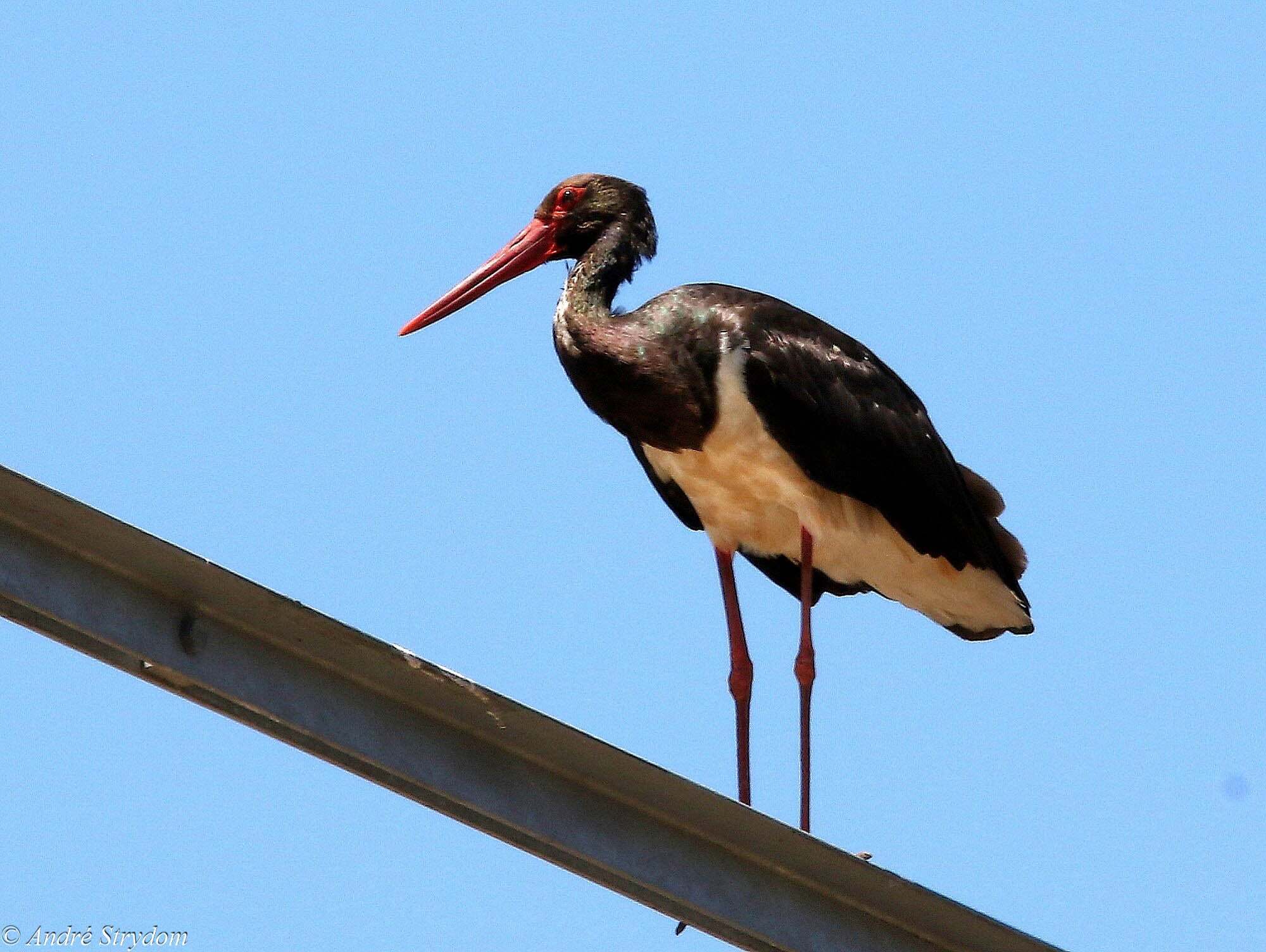
Ciconia nigra
Identity and identification
Black Stork Ciconia nigra belongs to Ciconiidae. Glossy black covers most of the body, contrasting with a white belly and adult red bill and legs. Juveniles are duller with less red bills. It flies with its neck extended like White Stork, but shows much less white. It is placed in the order Ciconiiformes. The IUCN category carried in AviList 2026 is Least Concern (LC).
Habitat, food and behaviour
More secretive than White Stork, it uses rivers, pools and wetlands near woodland or quiet sites. Fish, amphibians and other small aquatic prey form its diet. Migrants soar on rising air and stop at wetlands for food and rest.
Breeding and parental care
A large nest occupies a tree or rock ledge within the breeding range. Usually three to five eggs are incubated by both parents for about 32–38 days. Young reach flight at roughly 63–71 days and receive further care. These general durations do not demonstrate nesting in a passage country.
Range and Arab occurrence
Migration links Eurasian breeding areas with African wintering grounds. In Lebanon it is a passage migrant, recorded from mid-February to mid-June and mid-August to early November. These records establish neither Lebanese residence nor breeding; other countries require their own status descriptions.
Seasonality and observation
Early November can coincide with the end of eastern Mediterranean autumn passage. Distinguish high travelling flocks from birds stopping to feed. Counts, direction and time document migration more usefully than closely approaching a resting individual.
Ecological role and conservation
A network of quiet wetlands supports the migration route. Electrocution, collisions, illegal shooting and degraded water habitats are pressures. Protecting stopovers complements protection of distant nests because the journey depends on multiple habitats.
References
Ramadan-Jaradi et al. — Updated checklist of the birds of Lebanon, Sandgrouse 42 (2020), 186–238.
University of Michigan Museum of Zoology — Animal Diversity Web: Ciconia nigra.
AviList Core Team — AviList: The Global Avian Checklist, v2026 (20 October 2026).
Photo: Dave Brown — CC0 1.0.