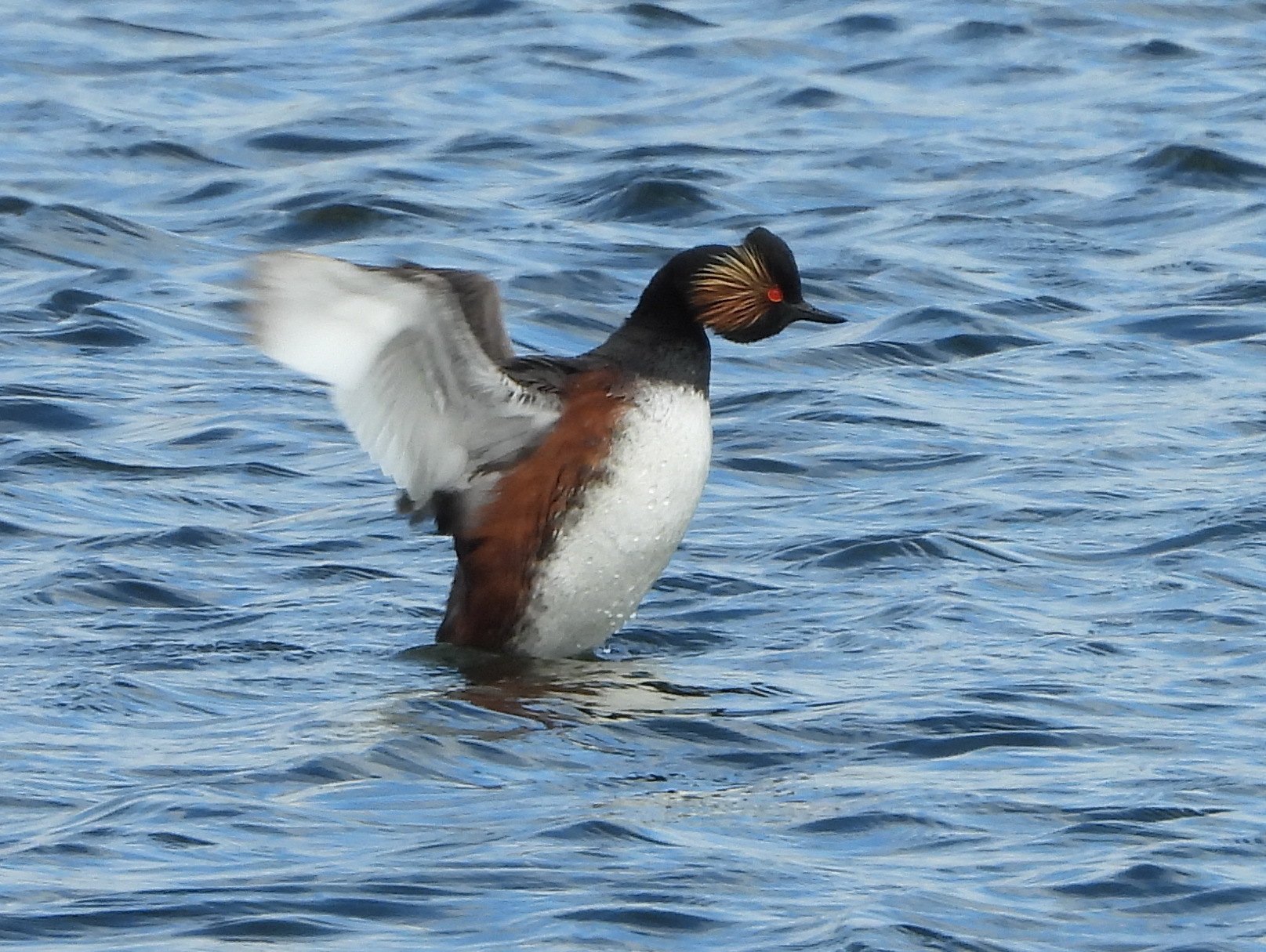
Podiceps nigricollis — a diving waterbird with contrasting seasonal plumages
Name and classification
The Black-necked Grebe, Podiceps nigricollis, belongs to Podicipedidae in the order Podicipediformes. North American references call it Eared Grebe; the Saudi reference also records the Arabic name Ghattas adraʿ. AviList 2026 places it among the grebes, specialised swimming and diving birds. It occurs in parts of Eurasia, Africa and North America, with populations ranging from resident to seasonally migratory. Its principal name describes breeding plumage more closely than the paler appearance familiar during winter.
Field identification
Breeding birds show a black head and neck, golden tufts behind the red eyes and chestnut flanks. In winter the contrast softens: the cheeks and lower neck become pale beneath a dark cap. The fine, slightly upturned bill and high crown above the eye remain useful features. The sexes have similar plumage; juveniles are closer to the non-breeding appearance before developing the bright adult pattern. Winter Horned Grebe is a frequent confusion species but has a stronger bill and a more sharply defined boundary between dark cap and white cheek. Little Grebe differs in bill structure, head shape and its less extensively white winter appearance. Use the combination rather than one mark.
Habitat, food and behaviour
It uses lakes, pools and marshes, moving outside the breeding season to larger lakes, brackish or saline waters and sheltered coastal bays. Diving brings aquatic insects and larvae, crustaceans and molluscs, with small fish and other prey taken according to local conditions. Some saline lakes rich in invertebrates attract large gatherings, while other sites hold smaller groups. Its use of salt water does not make it exclusively marine: habitat choice changes through the year with food, breeding and moult. An observer may see a bird disappear underwater and resurface some distance from the point where it dived.
Breeding and life cycle
Pair displays on the water precede nesting, and many pairs may breed close together. Both adults build a platform of aquatic vegetation anchored among reeds or other emergent plants. The British reference gives a usual clutch of three to four eggs and incubation by both sexes for twenty to twenty-two days. Downy chicks can move and swim early, but adults carry them on their backs and feed them. Parents may divide the brood between them. Leaving the floating nest is therefore distinct from becoming fully grown or capable of flight: young birds continue to depend on parental care during early development.
Arab distribution and November
The 2026 Lebanese guide classifies it as an uncommon winter visitor and passage migrant on wetlands and the coast; Kuwait’s list gives a similar status. In Oman it is a common winter visitor with breeding documented on limited occasions. The Saudi reference describes scarce winter occurrence and records historical breeding in the south-western highlands; this is different from treating all Saudi birds as resident breeders. Moroccan studies document wintering birds and local breeding populations, while the winter range includes North African coasts. November coverage therefore suits the arrival of winter birds in the Levant and Gulf, alongside important local breeding exceptions.
Conservation and responsible observation
Its global category is Least Concern, LC. Nevertheless, pollution, habitat loss, altered water levels, disturbance at breeding sites and illegal hunting can affect local populations. Floating nests depend on suitable water and vegetation, and protecting several sites is useful because birds move between them. Watch from shore or a distant fixed position, allowing extra space around nests or chicks. Do not pursue a diving bird by boat: repeated diving can be a response to disturbance rather than a photographic opportunity. Notes on location, date and behaviour help distinguish winter occurrence from local breeding.
References
AviList Core Team — AviList v2026, 20 October 2026.
Ramadan-Jaradi & Itani — Birds of Lebanon: A Photographic Guide to 409 Species, second edition, UNDP, June 2026, p. 67.
British Trust for Ornithology — BirdFacts: Black-necked Grebe.
Cornell Lab of Ornithology — All About Birds: Eared Grebe, life history; Audubon — Eared Grebe.
National Center for Wildlife — The Birds of Saudi Arabia, volume 2, Black-necked Grebe.
Kuwait Ornithological Rarities Committee — Kuwait Bird List; Birds of Oman — national species database.
Diversity and Population Sizes of Wintering Waterbirds in Wetlands of the Saïss–Middle Atlas Region, Morocco, 2024.
Photo: Лариса Артемьева — CC0 1.0.