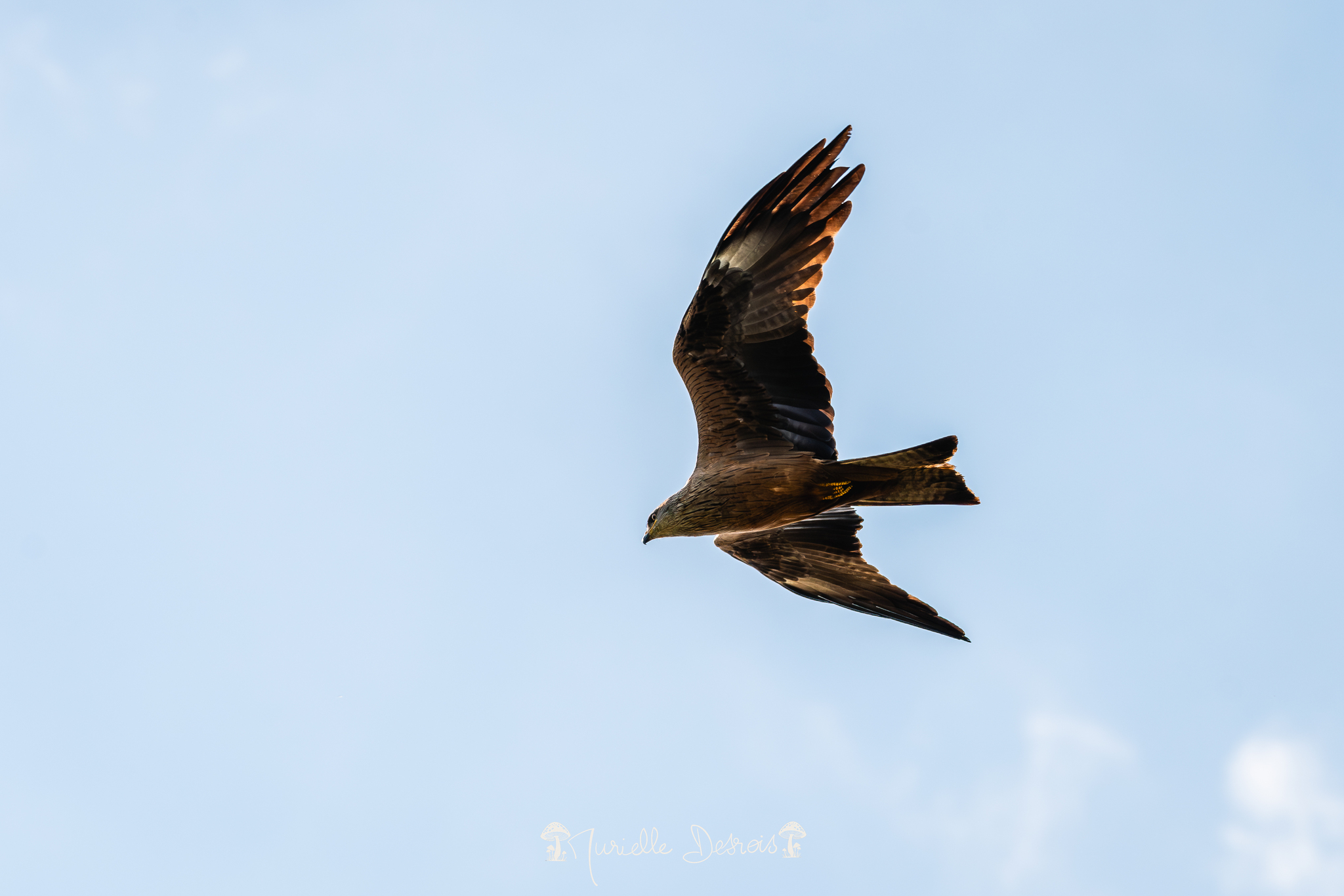
Milvus migrans
Identity and identification
Black Kite Milvus migrans belongs to Accipitridae. Brown and long-winged, it has a shallowly forked tail that can look square when spread. Juveniles are more spotted. Compared with Red Kite, the tail is shorter and less deeply forked. Some references split Yellow-billed Kite, whereas AviList 2026 includes it within M. migrans pending further research. It is placed in the order Accipitriformes.
Habitat, food and behaviour
Open country, water, urban edges and sites with prey or carrion provide food. It takes fish, small animals and scraps and may steal from other birds. Large gatherings at a dump demonstrate food concentration, not necessarily safe food or healthy habitat.
Breeding and parental care
A twig nest usually stands in a tree, sometimes on rock, and may incorporate collected lining material. Two or three eggs are usual; incubation lasts about a month. Chicks require roughly six to eight weeks before flight and further care afterwards. Details vary geographically.
Range and Arab occurrence
Widespread in the Old World, it includes resident and migratory populations. Lebanon’s updated checklist describes passage and winter visits from early September to late April. Comparisons must state the taxonomy used, because including the Yellow-billed group changes the species’ scope. Lebanese seasonality should not be generalised across Arab Africa.
Seasonality and observation
November falls within Lebanese winter occurrence. Distant views of flight and tail are useful, remembering that a spread tail hides its fork. A sequence during turns gives better evidence than one frame.
Ecological role and conservation
Carrion consumption is an ecological role, but poisons, accidental plastic ingestion and electrocution are risks. Waste, toxicant and power-line management help. Deliberately attracting kites with unknown scraps can turn apparent food into a poisoning source.
References
Ramadan-Jaradi et al. — Updated checklist of the birds of Lebanon, Sandgrouse 42 (2020), 186–238.
University of Michigan Museum of Zoology — Animal Diversity Web: Milvus migrans.
AviList Core Team — AviList: The Global Avian Checklist, v2026 (20 October 2026).
Photo: Murielle Desrois — CC0 1.0.