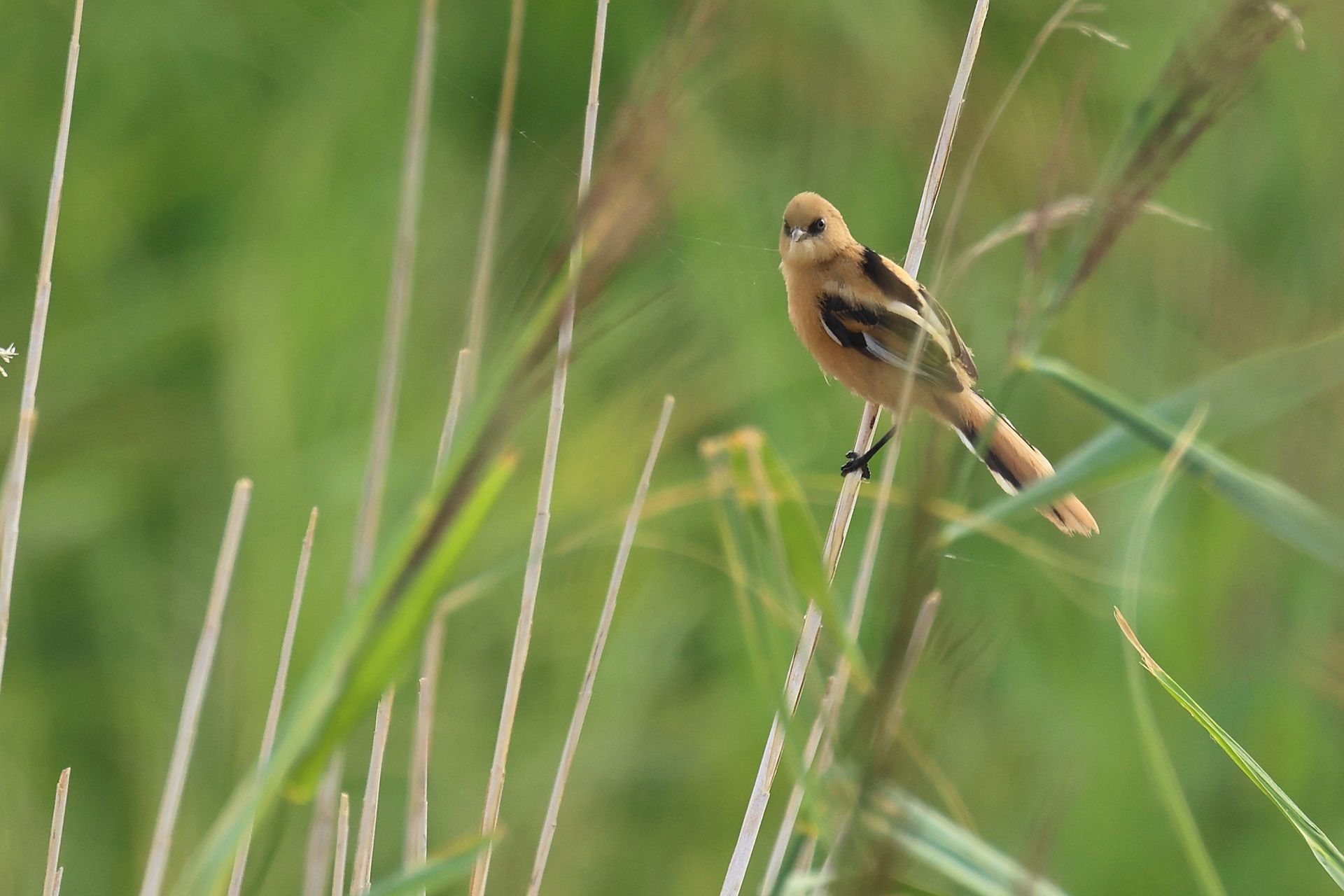
Panurus biarmicus
Identity and names
Bearded Reedling, Panurus biarmicus, is Panure à moustaches in French and also known as Bearded Tit. Despite that alternative English name and Arabic names referring to a tit, it belongs to Panuridae, not the true-tit family Paridae. Its total length is about 14–17 cm, including a conspicuous long tail, and it weighs around 15 g. A small, rounded body combined with that tail creates a silhouette unlike most brown reedbed birds.
Identification
The male has a blue-grey head and black drooping moustachial marks beside a pale throat, above a largely cinnamon-brown body. The famous facial feature is therefore closer to moustaches than a beard. Females are plainer and lack those black marks; juveniles may show a black patch on the back. Wings are short and the bill compact. A long tail alone is insufficient: combine body shape, facial pattern, behaviour and habitat, especially during brief views between moving reed stems.
Habitat, food and behaviour
Extensive dense reedbeds are its characteristic habitat. Birds climb stems, disappear through vegetation and occasionally emerge on seed heads. Insects, larvae and other invertebrates feature strongly during warmer months, while seeds, including reed seeds, become more important in winter. Small swallowed grit particles help the gizzard process plant food; they are not a substitute for nourishment. Short ringing calls may reveal birds before they become visible. Understanding the reedbed itself is essential to interpreting their presence.
Range and Arab occurrence
Distribution is patchy across Europe and Asia, following suitable reeds, and Arab occurrence varies sharply. Published Syrian evidence includes fledged young at Sed Wadi Abied in August 1998 and resident breeding populations in suitable Euphrates and Jabbul reedbeds. These are historical, site-based records, not a current census of all Syria. Lebanon’s 2026 guide instead treats it as a vagrant, citing six at Aammiq in March 1996 and two at Anjar in April 2005. It is not a regular winter visitor to every Levantine wetland.
Breeding and development
The pair builds a cup nest among tangled vegetation low above water or mud. BTO gives a usual clutch of 4–8 eggs, shared incubation of about 10–14 days and fledging around 12–13 days after hatching. Chicks hatch helpless and need feeding and protection; care continues after nest departure. Further broods may follow in a suitable season, but water, vegetation and weather affect success. European breeding months should not automatically be transferred to an individual Arab locality.
November and responsible observation
In November, birds may gather in flocks and move among reed patches within their range, with occasional wider dispersal. Listening from an existing wetland edge is preferable to opening a new route through reeds. Record numbers, location and vegetation, seeking photographs of face and tail without playback to draw birds out. A possible Lebanese observation needs careful documentation rather than an immediate claim of new residence. Conversely, failure to see birds during a windy visit does not demonstrate disappearance.
Conservation
Its global category is Least Concern, but specialisation ties its future to healthy wetlands. Drainage, degradation, disturbance and lost cover can reduce usable habitat. Reed management must consider breeding and roosting places and their seasons instead of clearing a large area indiscriminately. Protecting water and connected cover benefits other wetland species too. A male’s attractive appearance never justifies approaching a nest or cutting stems for a cleaner photograph; safeguarding habitat matters more than the image.
References
AviList Core Team — AviList v2026; British Trust for Ornithology — BirdFacts: Bearded Tit; RSPB — Bearded Tit; Oiseaux.net — Panure à moustaches; UNDP / ABCL / Ministry of Environment — Birds of Lebanon, 2026, p. 276; Murdoch and Betton — A checklist of the birds of Syria, Sandgrouse Supplement 2, 2008, p. 28.
Photo: José Antonio León Mangado