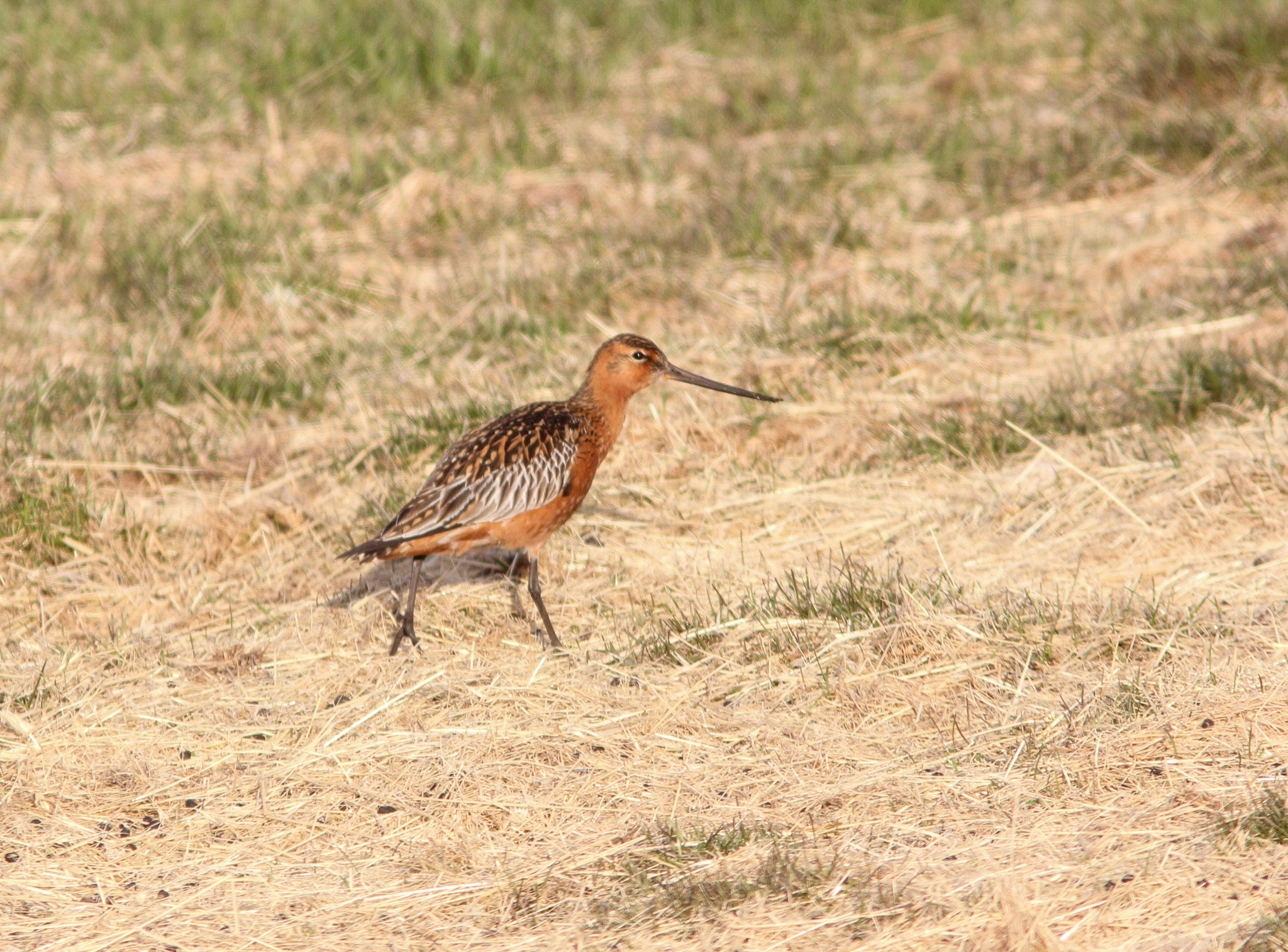
Limosa lapponica — a coastal wader and long-distance migrant
Name and classification
The Bar-tailed Godwit, Limosa lapponica, is a member of Scolopacidae in the order Charadriiformes. The Lebanese guide gives an expanded Arabic name, while Kuwaiti references use the shorter equivalent of Bar-tailed Godwit. AviList 2026 recognises the same species, whose geographical populations follow different migration routes. Its northern tundra breeding grounds extend from Scandinavia through Russia to Alaska, while wintering areas span extensive coastlines in Europe, Africa, the Middle East, Asia and Oceania.
Field identification
The long bill curves slightly upwards and usually has a pink base and dark tip. Winter birds are grey-brown above and pale below, with conspicuously patterned upperparts. Breeding males develop rich rusty colour on the face, neck and underparts; females are generally paler, larger and longer-billed. Juveniles resemble winter birds but have buff-toned feather margins. In flight, the barred tail and absence of a broad white wing stripe distinguish it from Black-tailed Godwit, which has a strong black tail-end and broad white wing bar. Winter plumage colour alone is insufficient for identification.
Habitat, food and behaviour
Outside the breeding season it depends on coastal mudflats, estuaries, sheltered bays and shallow shores, sometimes beside mangroves. It probes sediment for marine worms, molluscs and crustaceans. Feeding follows the exposure of suitable ground by the tide; at high water birds gather at roosts above the waterline. A safe resting place therefore complements the feeding flat, and repeated disturbance at either can reduce time available for recovering energy. On the breeding grounds it exploits tundra resources, including insects and their larvae.
Breeding and life cycle
The nest is a ground hollow among tundra vegetation, sometimes lined with moss and other plant material. A usual clutch contains four eggs, and both parents take part in incubation and care. The British reference gives an incubation period of twenty to twenty-one days. Chicks leave the nest early and find their own food, while the adults guard and brood them. The New Zealand reference, describing Alaska-breeding birds that migrate to New Zealand, gives fledging at about twenty-eight to thirty days. That figure concerns a specified population; laying and migration schedules differ across the species’ range.
Arab distribution and November
Records place it on Arab coasts in North Africa and the Arabian Peninsula, within a winter range linking Africa and the Middle East. Oman’s database calls it an abundant passage migrant and winter visitor; Kuwait’s list describes a common passage migrant but uncommon winter and summer visitor. Lebanon is markedly different: the 2026 guide treats it as a vagrant, listing five records rather than a regular winter population. November coverage is consequently especially relevant to Gulf and Omani tidal flats, while Lebanese observations require careful identification and documentation. Record-breaking Pacific flights do not automatically describe the journeys of birds using Arab shores: populations follow different routes.
Conservation and responsible observation
Its global category is Near Threatened, NT, more precise than treating an old description as evidence of security. Populations face the loss of tidal flats, coastal reclamation, pollution and disturbance, with pressures differing between flyways. Protecting both feeding grounds and roosts supports a bird that must accumulate sufficient energy between migration stages. Observe and photograph from a fixed position away from the flock, avoiding any approach that forces flight, particularly at high tide when alternative resting ground is limited. Global conservation status remains separate from each country’s hunting legislation.
References
AviList Core Team — AviList v2026, 20 October 2026.
Ramadan-Jaradi & Itani — Birds of Lebanon: A Photographic Guide to 409 Species, second edition, UNDP, June 2026, p. 154.
British Trust for Ornithology — BirdFacts: Bar-tailed Godwit.
BirdLife Australia — Bar-tailed Godwit; New Zealand Birds Online — Bar-tailed Godwit, updated 2022.
Kuwait Ornithological Rarities Committee — Kuwait Bird List; Birds of Oman — national species database.
Convention on Migratory Species — Limosa lapponica; Bird Society of Singapore — Bar-tailed Godwit.
Photo: Tero Linjama — CC0 1.0.