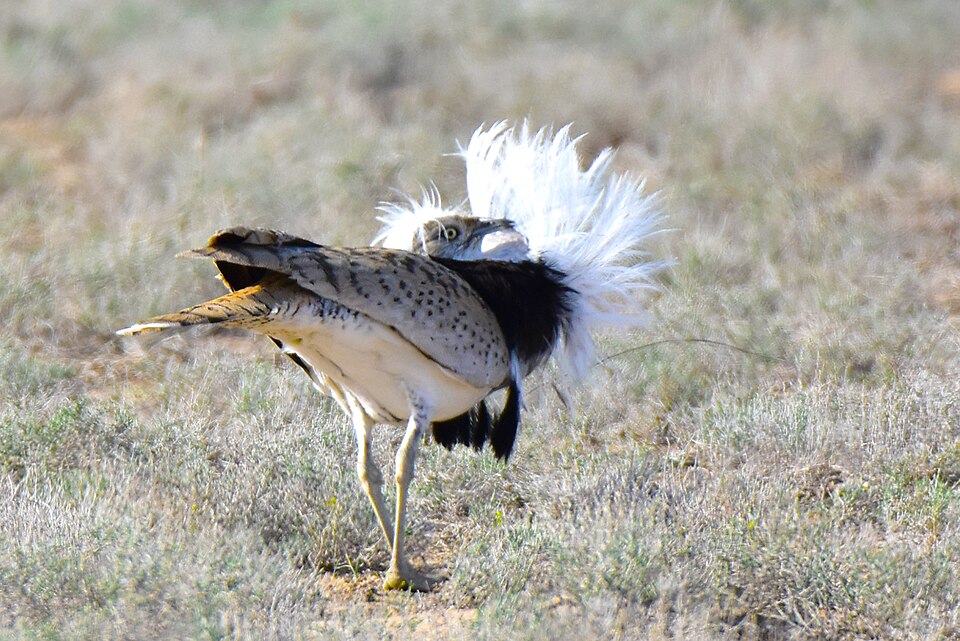
_male_courtship,_Kazakhstan.jpg)
Asian houbara (MacQueen’s bustard) — Chlamydotis macqueenii
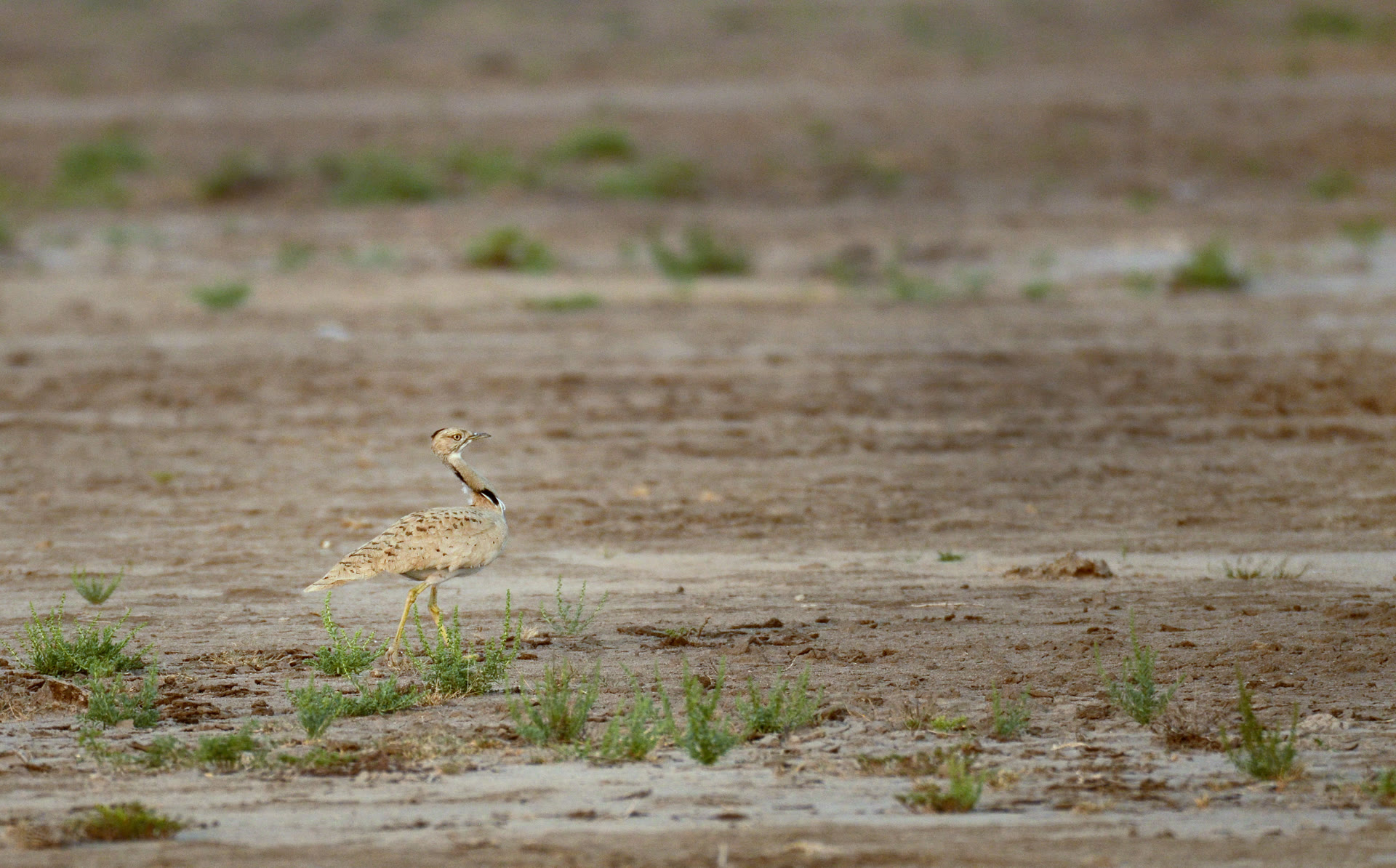
Range: A sleek desert bird of the bustard family. Its range runs from east of Sinai across Iran and Central Asia to the Gobi Desert in Mongolia; northern populations are partial migrants wintering south toward Pakistan, western India, and parts of the Arabian Peninsula. In the Levant it was historically wider in dry steppe; today it is rare or only a vagrant in the Lebanese context compared with soaring migrants. This entry locks Chlamydotis macqueenii only. The African houbara Chlamydotis undulata—North Africa and the Canary Islands—is a separate species elevated in 2003, paler, with different crest feathers in display and a Maghrebi range, not Asian–Levantine; it must not be mixed with the species treated here.
Life cycle and habitat: The male performs a striking visual display: inflating neck feathers and folding the head into a “ruff,” then running in lines or circles around shrubs. Mating is polygynous on the male’s side; the female alone tends the nest. She usually lays 2–4 eggs in an open scrape; incubation lasts about 23 days. Precocial chicks follow the mother. It prefers arid desert and steppe with sparse shrub cover; the diet mixes seeds, berries, and insects, and it can forgo free water when food moisture suffices.
Lifestyle: Wary, relying on camouflage and crouching low when approached. When pursued it rises and spirals upward. Sensitive to nesting disturbance by people and livestock. Migration routes avoid the highest mountain chains, as satellite tracking has shown; breeding timing links to local temperatures that trigger spring departure.

Hunting status: Across Arab countries, Asian houbara is generally protected and hunting is tightly restricted; the species is globally threatened. In Lebanon, Wild Hunting Law No. 580/2004 limits hunting to quarry species set by the minister; everything else is protected year-round; houbara is not among the permitted quarry in the absence of a current open-season decision. Documented exceptions only within licensed falconry frameworks: in Qatar, Ministerial Decision No. 7 of 2026 lists houbara among species that may be taken with falcons only during a set period (1 September 2026 – 15 February 2027), and bans call-playback devices (Ministry of Environment and Climate Change via Qatar News Agency). In Abu Dhabi, within licensed traditional falconry under Executive Council Decision 5/2021 and Environment Agency – Abu Dhabi notices, houbara may be taken by licensed falconers in defined seasons—without implying that all hunting pathways in the emirate are limited to houbara alone.
Conservation status: Globally Vulnerable (VU) with the International Union for Conservation of Nature (BirdLife assessment 2021), owing to declines tied to hunting and habitat degradation. Listed on CITES Appendix I and CMS Appendix II. Captive-breeding and release programs form part of the conservation response across parts of the range.
Traits: The male’s display is documented courtship, not invented folklore: neck plumes folded over the head, measured pacing, and a soft breathing sound audible only at close range. Doing without free water is a true desert adaptation. An icon of falconry heritage and of conservation duty alike.