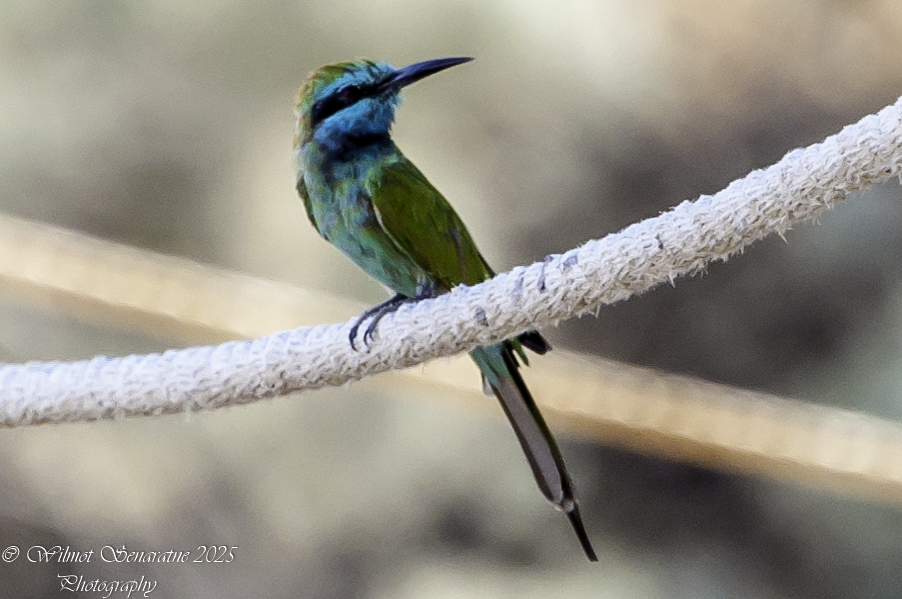
Merops cyanophrys
Identity and identification
Arabian Green Bee-eater Merops cyanophrys belongs to Meropidae. Green plumage, a black eye stripe, conspicuous blue face and throat and elongated adult central tail feathers characterise it. It was split from the former green bee-eater complex; old Merops orientalis photographs require geographic and diagnostic checks. It is placed in the order Coraciiformes. The IUCN category carried in AviList 2026 is Least Concern (LC).
Habitat, food and behaviour
Wadis, farmland, gardens and dry country with exposed perches provide habitat. It sallies for flying insects and often returns to a perch. Bees, wasps and other flying insects are eaten; the name does not imply exclusive dependence on managed honeybees.
Breeding and parental care
It excavates a nesting tunnel in suitable soil, ending in an internal chamber. Adults bring insects to the young. A stable bank or small earth face is important for nesting success. Never expose a chamber or insert an object into the tunnel to check occupancy.
Range and Arab occurrence
Associated with Arabia and the southern Levant, it occurs in Saudi Arabia, Oman, Yemen and adjoining areas. The Birds of AlUla guide documents Saudi occurrence, supported by Omani and Jordanian observations. Its range differs from African and Asian green bee-eaters formerly combined with it.
Seasonality and observation
It is resident across suitable parts of its Arab range, with local movements following food. November observations need not imply long-distance migration. Dated, accurately located photographs help distinguish resident groups from movements beyond usual sites.
Ecological role and conservation
It consumes flying insects and requires perches and safe earthen nesting sites. Pesticides, bank levelling and nest disturbance degrade habitat. Near apiaries, site management and documented feeding behaviour are preferable to assuming damage or killing birds.
References
Royal Commission for AlUla — Birds of AlUla, Arabian Green Bee-eater.
Saudi Aramco — Birds of Saudi Arabia, volume 2, Arabian Green Bee-eater.
AviList Core Team — AviList: The Global Avian Checklist, v2026 (20 October 2026).
Photo: wilmotsenaratne — CC0 1.0.