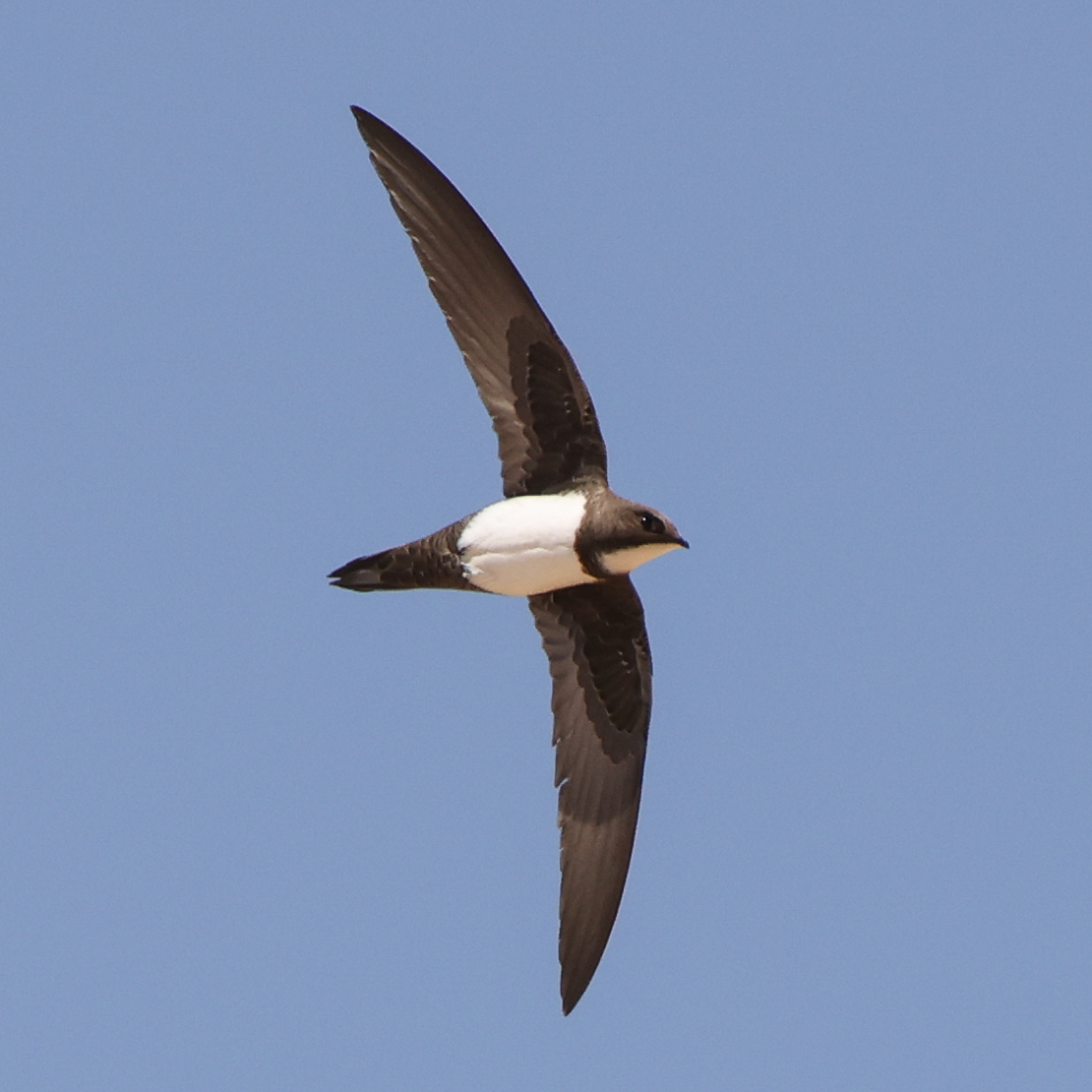
Tachymarptis melba
Identity and identification
Alpine Swift Tachymarptis melba belongs to Apodidae. Larger than Common and Pallid Swifts, it shows white belly and throat separated by a dark breast band. Wings are long and powerful. The older name Apus melba refers to the same species, not an additional encyclopedia bird. It is placed in the order Apodiformes. The IUCN category carried in AviList 2026 is Least Concern (LC).
Habitat, food and behaviour
It catches airborne insects above mountains, coasts and towns. Feeding birds may range far from nesting cliffs, so a feeding location does not locate a nest. Groups give strong calls; the white belly helps identify high-flying individuals.
Breeding and parental care
Rock and building crevices hold nests made with light material bound by saliva. Three eggs are usual; both parents incubate and feed young. Species references describe roughly six to ten weeks of nest care, varying with conditions. Nest departure requires adequate flight development.
Range and Arab occurrence
Its range includes southern Europe, North Africa and the Middle East, extending farther south and east. In Lebanon it is a local cliff-nesting migrant breeder and passage migrant. Birds above a coast are not necessarily nesting in every building they cross.
Seasonality and observation
Lebanon’s checklist gives breeding from February to July, spring passage in February–April and autumn passage from July to mid-October. November follows most usual local passage. Document belly and breast band to avoid confusion with other distant large birds.
Ecological role and conservation
Loss of nesting crevices, disturbance and changing insect supplies are pressures. Respecting cliff colonies during climbing and construction matters. Distant viewpoints permit belly views without approaching nests.
References
Ramadan-Jaradi et al. — Updated checklist of the birds of Lebanon, Sandgrouse 42 (2020), 186–238.
University of Michigan Museum of Zoology — Animal Diversity Web: Tachymarptis melba.
AviList Core Team — AviList: The Global Avian Checklist, v2026 (20 October 2026).
Photo: Paulo Caseirito — CC0 1.0.