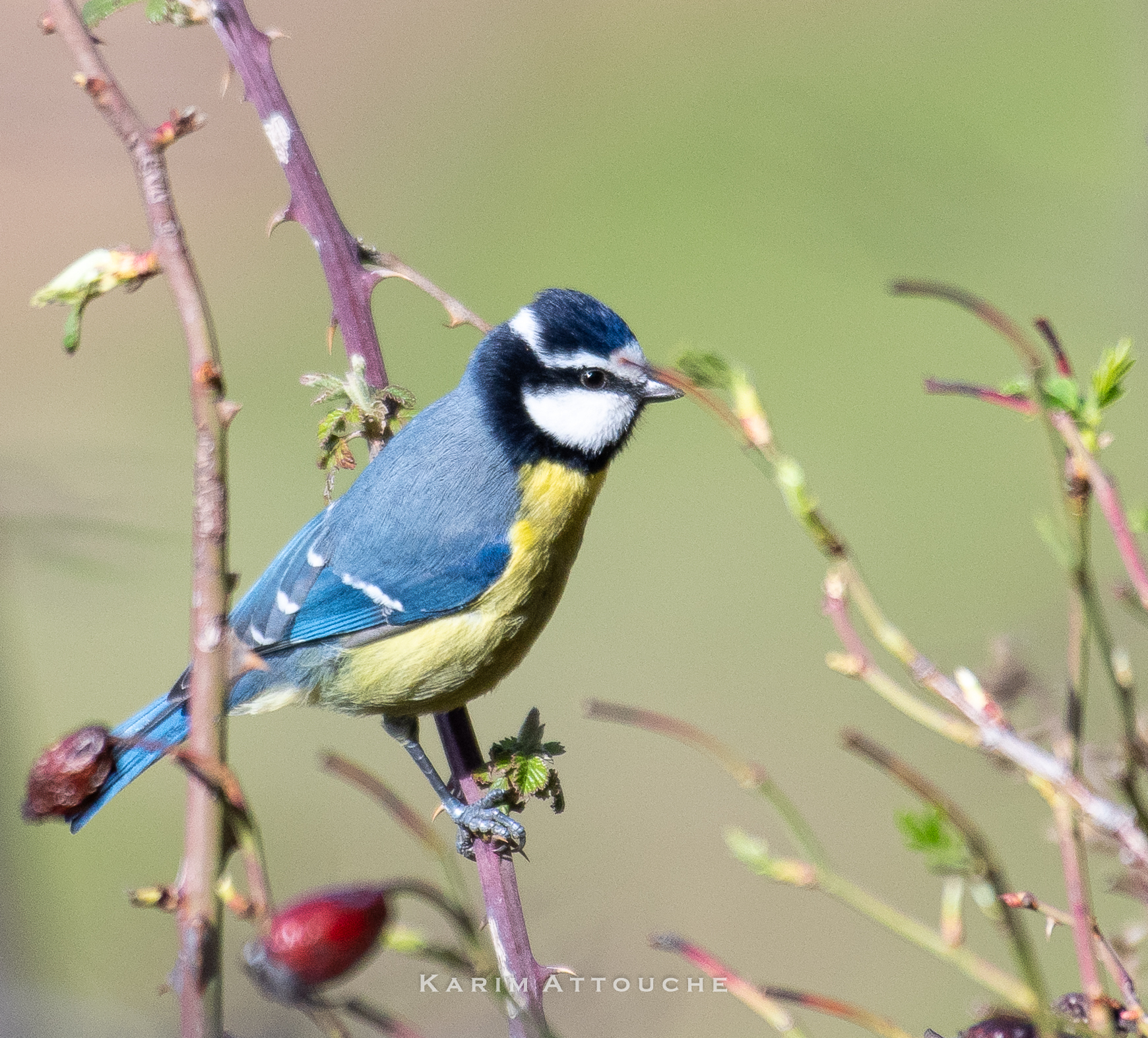
Cyanistes teneriffae
Identity and names
The African Blue Tit, Cyanistes teneriffae, belongs to Paridae and Passeriformes. French uses Mésange nord-africaine; the mainland form is also called Mésange maghrébine, reflected in the Arabic name “Maghreb tit”. AviList 2026 includes the North African and Canary Island populations within this species, separate from Eurasian Blue Tit Cyanistes caeruleus. Some publications split these populations differently, so names must be read with their scientific context. The species measures about 11–12 cm and weighs roughly 10–13 g; these are approximate dimensions, not measurements unique to each subspecies.
Identification
North African birds combine a dark blue crown and blue-toned upperparts with a white face, strong dark eye stripe and yellow underparts. The darker crown helps distinguish them from the familiar Eurasian species, but light and age can change appearances. Mainland ultramarinus has a pale wing bar: the absence of a wing bar in some Canary Island forms must not be presented as a universal identification feature. Young birds are duller and have yellower facial areas. Check the face, back and wing together, and retain locality information with any photograph.
Habitat, food and behaviour
This is a bird of wooded habitats, not an inhabitant of open Sahara simply because it is African. Oak woods, including cork-oak woodland, and other forest types provide feeding surfaces and nesting cavities. Algerian studies have examined populations in oak forests and montane cedar stands. Birds search foliage and twigs for invertebrates and can hang beneath branches; plant foods may supplement the diet. Research in northeastern Algeria found caterpillars important in nestling food. Protecting the insects available on trees is therefore part of protecting the bird, not a separate conservation issue.
Range and Arab occurrence
AviList places ultramarinus from Morocco through Algeria to Tunisia, and also on Pantelleria, while cyrenaicae occurs in northeastern Libya. The Canary Islands support other named forms and are not Arab breeding localities. Morocco’s checklist identifies a resident breeder; Algerian field studies independently document breeding populations. These mainland birds should not be described as European winter migrants, nor should their distribution be assigned to Eurasian Blue Tit. The Libyan form has a separate, restricted geographic occurrence, not an uninterrupted range across every desert between Tunisia and Cyrenaica. Country and habitat remain essential parts of an accurate record.
Breeding and development
The nest occupies a cavity, including suitable nest boxes. Reproduction varies with woodland type and elevation: Algerian research found differences in laying dates and clutch sizes even between nearby study populations. Average clutches at some Algerian sites were around 6–7 eggs, with variation between sites and years. After incubation and hatching, chicks remain inside the cavity and depend on food brought by adults. They need a regular food supply at this stage, highlighting the importance of caterpillars collected from tree foliage. The cavity shelters the young until they are able to leave the nest.
November and responsible observation
In November, interest lies in the daily life of resident woodland birds: where they find food, which trees they use and how they move through the canopy. Their presence is not itself evidence of autumn arrival. Observe from paths, record the locality and habitat, and avoid entering vegetation or repeatedly using recordings to draw birds closer. Viewing the face and wing together, in natural light and from a distance comfortable for the bird, helps reveal its markings. Do not open tree cavities for a better view or pursue a bird returning to cover to feed.
Conservation
AviList 2026 reports the global IUCN category as Least Concern for the species in its broad taxonomic sense. That assessment does not establish the condition of every isolated population. Conserving mature native woodland, cavity-bearing trees and connected feeding cover is valuable. Research on Algerian birds has investigated nest predation, parasites and pollution, showing why breeding outcomes must be studied locally. Avoid unnecessary insecticide use and disturbance around cavities. A global category also confers no permission to trap birds or remove eggs, and local protection requirements remain applicable.
References
AviList Core Team — The Global Avian Checklist, v2026; Bergier et al. — Liste des oiseaux du Maroc, 2017; Oiseaux.net — Mésange nord-africaine; Chabi et al. — Breeding ecology of the North-African Blue Tit in two semi-evergreen oak forests in Algeria, 1995; Djenidi and Bouslama — Reproductive phenology and nestling diet of African Blue Tit, 2014; European Zoological Journal — Subtle differences in breeding performance between Great Tits and Afrocanarian Blue Tits in NE Algeria, 2020; Current Zoology — Sexual dichromatism, size dimorphism, and microscale anatomy of white wing stripe in blue tits, 2021.
Photo: karim Attouche