Anas platyrhynchos — Identification, habitats, breeding and occurrence in the Arab region
Identity and recognition
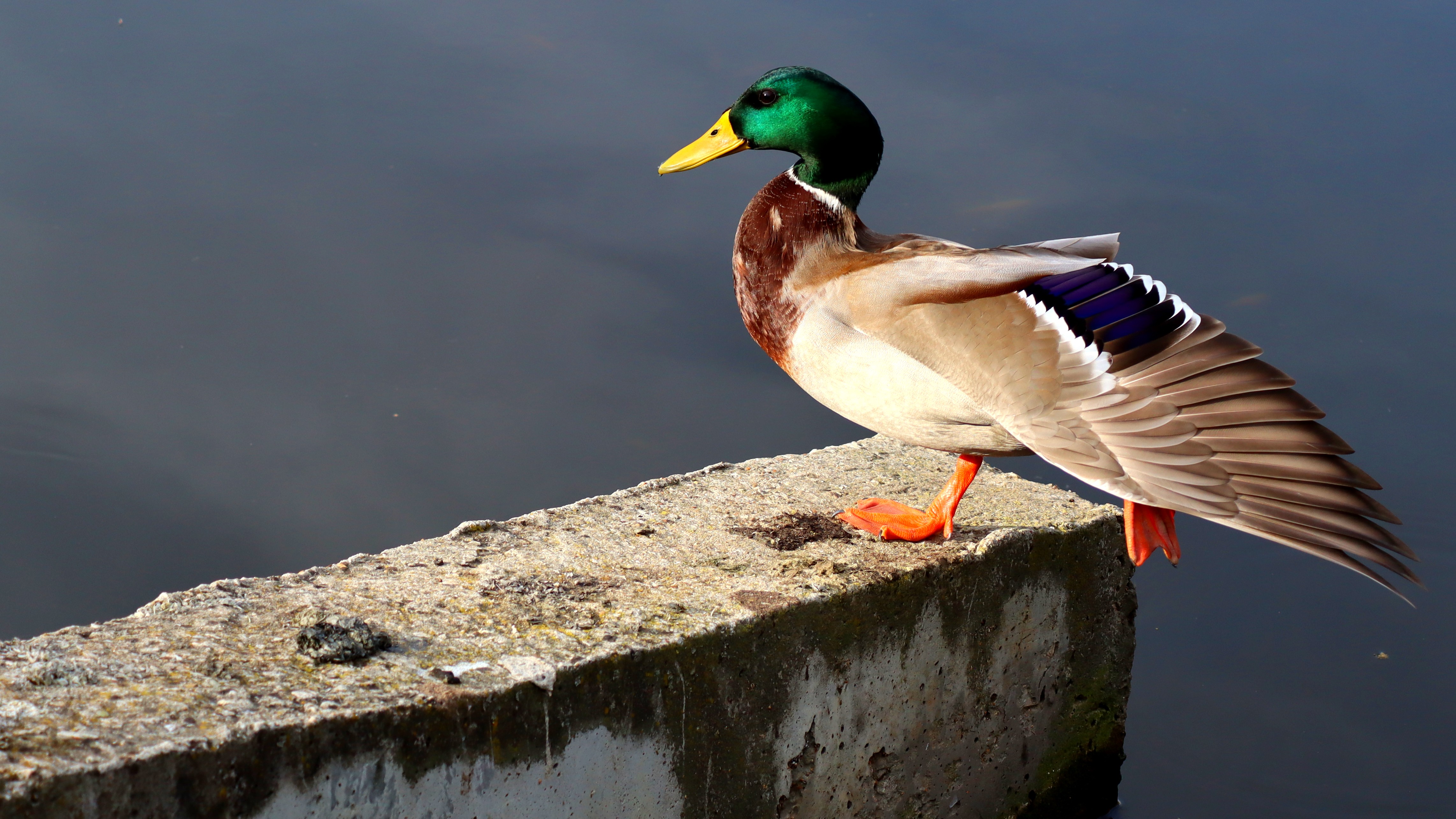
The Mallard, Anas platyrhynchos, is a dabbling duck in the family Anatidae. A typical wild bird is about 50–65 cm long. The breeding-plumaged male combines a glossy green head, narrow white neck ring, chestnut breast and grey body; the central black tail feathers curl upwards. The female is mottled brown, with an orange-brown bill carrying darker markings. Both show a blue-violet wing panel bordered with white. Young birds resemble females. During eclipse, adult males also become brownish, so a green head is not a year-round identification requirement.
Distinguishing similar birds
Compare the wing panel, bill, body proportions and voice rather than relying on brown plumage alone. Female Gadwalls show a white wing patch rather than the Mallard’s blue-violet panel. A female Mallard gives the familiar loud quack; males have a quieter rasping voice. Domestic descendants and hybrids may be unusually large, white, patchy or otherwise unlike textbook wild birds. Their presence in a park does not, by itself, establish a native breeding population.
Habitat, feeding and behaviour
Shallow lakes, marshes, slow rivers, reservoirs, lagoons and managed ponds can all support this adaptable species. It feeds by picking, dabbling, dipping its head and tipping forwards, also grazing or gathering seeds on land. Foods include aquatic vegetation, seeds and invertebrates; animal food is particularly important during breeding and growth. Mallards often rest communally and mix with other ducks outside nesting territories. Birds accustomed to people may approach closely, while hunted populations can remain very wary.
Breeding and annual cycle
Pairs commonly form before the breeding season, but this is not lifelong pair bonding. The female makes a concealed, down-lined nest, usually on the ground near water, although unusual elevated sites occur. Clutch size varies: British nest records give a typical 11–14 eggs. The female incubates for approximately 27–28 days and tends the downy young. Ducklings leave the nest soon after hatching, feed for themselves and usually fly at roughly 50–60 days. Adults replace their flight feathers together and are temporarily flightless; sheltered wetlands are particularly valuable during this vulnerable period.
Arab-region distribution and seasonality
Resident and migratory populations coexist across the wider range; northern breeding birds commonly move south. Arabian occurrence should not be reduced to one calendar. Eastern Saudi records place passage and winter birds broadly from late August to May, with concentrations mainly September–March. Riyadh records include breeding, but the Saudi national account identifies ornamental introductions as the origin of established feral residents. Kuwait reports passage and winter visitors, occasional summer birds and historical breeding. A summer sighting alone therefore cannot establish either wild origin or nesting. In Lebanon, the 2020 checklist records passage and winter presence from August to early April, with local breeding. Morocco supports resident breeders and winter visitors.
Ecology and conservation
As a consumer of plants and small animals, and prey for predators, the Mallard participates in wetland food webs. Wetland loss, poor water quality, disturbance and shooting can affect local populations; mixing with domestic stock complicates conservation and monitoring. The 2025 global IUCN assessment lists Least Concern but a decreasing population trend. This does not mean every local population is secure. Retaining quiet, vegetated shores, dependable water and connected wetland habitat supports nesting, moulting and wintering birds.
References
Naturalis — Birds of Europe: Mallard
RSPB — Gadwall
Cornell Lab of Ornithology — All About Birds: Mallard Life History
Cornell Lab of Ornithology — Mallard Overview
British Trust for Ornithology — BirdFacts: Mallard
Ducks Unlimited — Mallard Annual Life Cycle
Birds of Saudi Arabia — Large group of Mallards in a field, Haradh
The Birds of Saudi Arabia — species accounts
KuwaitBirds — Mallard
BirdLife International — IUCN Red List assessment of Anas platyrhynchos, 2025
Missouri Department of Conservation — Mallard
Ramadan-Jaradi and colleagues — Updated checklist of the birds of Lebanon, Sandgrouse 42 (2020)
Squalli and colleagues — Wintering waterbirds of the Saïss–Middle Atlas, Animals (2024)
Photo: Iurie Nistor — CC0 1.0.