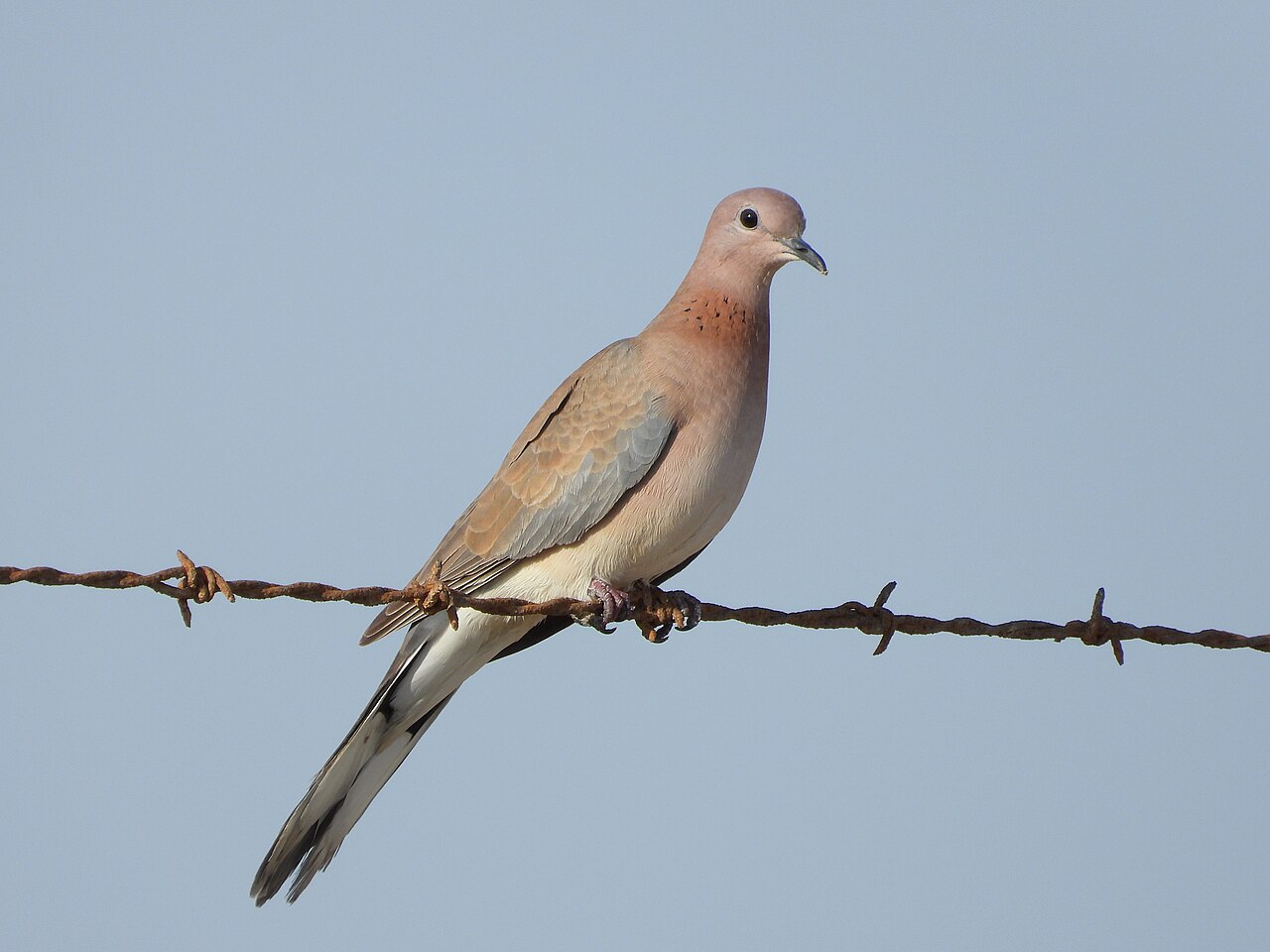
Spilopelia senegalensis — Identification, habitats, breeding and occurrence in the Arab region
Identity and identification
The Laughing Dove, Spilopelia senegalensis, is a small member of the pigeon and dove family, Columbidae, in the order Columbiformes. Also called Palm Dove, it is familiar around many Arab towns, farms and oases. At approximately 25–27 cm long, with a wingspan of about 40–45 cm, it combines a small head, slender body and relatively long tail.
Adults have warm pinkish-brown head and breast, a browner back and blue-grey areas on the wings. A patch of black spotting on a rusty background across the lower fore-neck is especially useful. White on the outer tail becomes conspicuous when the tail opens. The sexes are similar, and small colour differences are unreliable for identifying a single bird’s sex. Young birds are duller and have a weak or absent spotted neck patch.
Eurasian Collared Dove is larger and paler, with a simple dark half-collar behind the neck. European Turtle Dove shows more strongly patterned, dark-centred upperwing feathers and a striped neck patch. Laughing Dove has a plainer upperwing and longer-looking tail. These characters are best assessed together, rather than relying on size in an isolated photograph. Its soft, rolling series of coos gives rise to the English name; the bird is not expressing human laughter.
Habitat, food and behaviour
It occupies open scrub, lightly wooded country, orchards, cultivated land, gardens and settlements. In arid landscapes, watered gardens and oases provide food and vegetation for nesting. It also uses built structures, including sheltered ledges and plant containers. Dense buildings without food or nesting opportunities are less informative than the presence of suitable small patches of habitat.
Most food is collected on the ground. Small seeds and grains predominate, with some fruit, other plant material and insects. Birds walk and pick up individual food items, often as a pair or in small groups. Larger gatherings can form at concentrated food or water. Flight is quick, and a startled bird may rise abruptly. Pairs maintain breeding territories even where many birds occupy the same neighbourhood.
Breeding and life cycle
Courtship combines repeated cooing, body movements and display flights. Both partners contribute to the simple twig platform, usually in a tree or shrub but sometimes on a building. Two white eggs are usual. Both parents incubate and feed the young, which initially receive nutrient-rich crop milk. Incubation generally lasts about two weeks; young leave the nest roughly two weeks after hatching, with variation between populations and studies. They may still depend on their parents after leaving.
Breeding opportunities can recur within a year. In Saudi Arabia breeding is documented over a broad season, with much activity from late winter into summer. A Taif study recorded the onset in mid-February. Egyptian and Maghreb populations also breed seasonally, but local conditions matter: a documented Moroccan nest with eggs in August illustrates why a single narrow calendar is unsuitable.
Distribution and regional seasonality
Its extensive range covers much of Africa and parts of western, central and southern Asia; western Australian populations are introduced. It is principally resident, with dispersal and local movements associated with conditions rather than obligatory long-distance seasonal migration.
In Arabia it breeds widely in suitable settled and cultivated habitats, including Saudi Arabia, Oman and Kuwait. In the Mashriq, Lebanon has an established resident breeding population. Egypt supports resident breeders in settled and cultivated areas, with field studies in Sharkia and Sinai. In the Maghreb it breeds in orchards, towns and oases; its expansion across Morocco and other North African areas is well documented.
Ecology and conservation
A mainly seed-eating bird, it is also prey within terrestrial food webs. Global status is Least Concern. Local nesting losses can result from predation, disturbance or nest abandonment; indiscriminate shooting is another recorded pressure. Maintaining shrubs, orchard habitat and quiet nesting places benefits birds alongside people. Leave active nests undisturbed and enjoy the calls without approaching the birds.
References
SEO/BirdLife. Tórtola senegalesa.
Almalki, M. Breeding ecology of the laughing dove in Taif City, Kingdom of Saudi Arabia. Brazilian Journal of Biology 83, 2023.
Boucherit and collaborators. Traditional Orchards and Drivers of Reproductive Performance in a Northern Algerian Population of Laughing Doves. Journal of Biological and Environmental Sciences 14, 2020.
Salama and collaborators. Preliminary Study on Breeding Biology of the Palm Dove at Sharkia Governorate, Egypt. Zagazig Journal of Agricultural Research 51, 2024.
Ramadan-Jaradi and collaborators. Updated Checklist of the Birds of Lebanon. Sandgrouse 42, 2020.
White and collaborators. Resident breeding birds in the St Katherine Protectorate, south Sinai. Sandgrouse 30, 2008.
Go-South. Summer breeding of Laughing Dove at Foum el Oued, 2020.
Mpala Research Centre. Laughing Dove field guide.
Kuwait Birds. Laughing Dove species account.
Photo: The Great Mule of Eupatoria — CC0 1.0.