Passer domesticus — Identification, habitats, breeding and occurrence in the Arab region
Identity and appearance
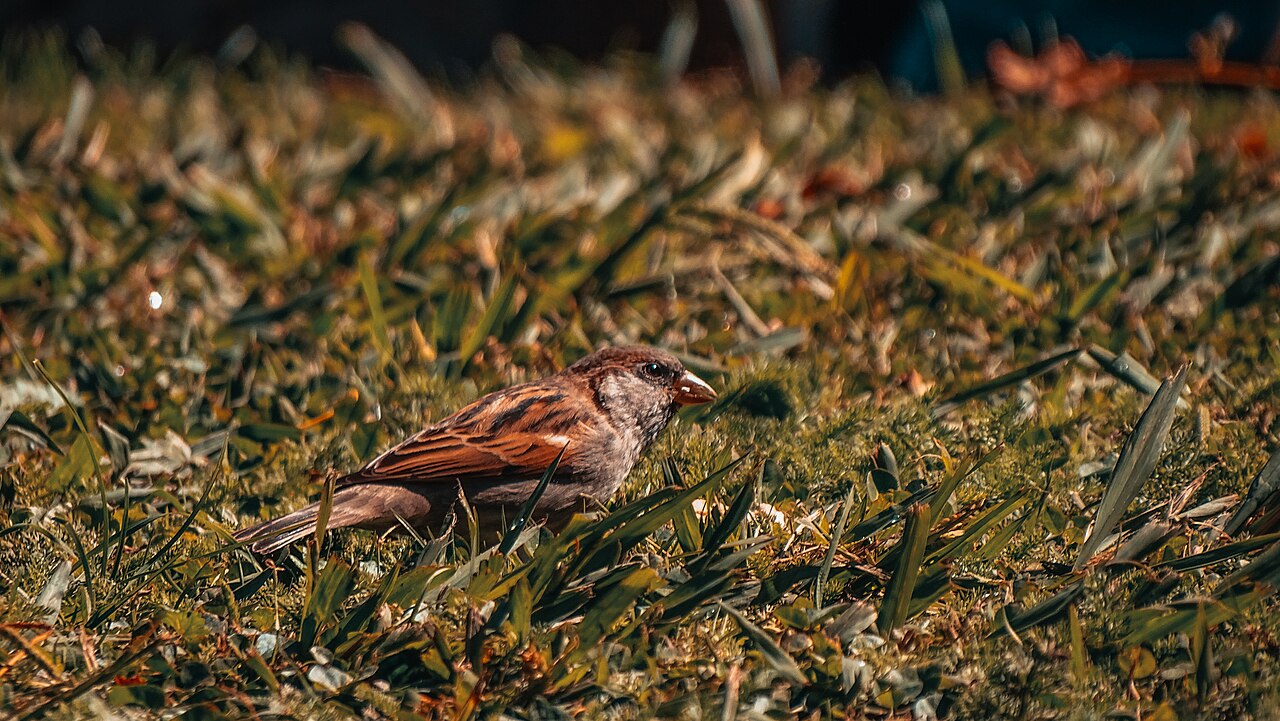
The House Sparrow, Passer domesticus, is a compact member of the Old World sparrow family Passeridae, usually about 15 cm long. Its stout, conical bill is suited to handling seeds. A typical adult male has a grey crown, chestnut at the sides of the head and neck, pale cheeks and a black throat bib. The back is brown and dark-streaked, with a pale wing bar. Females are quieter in pattern, with a buff eyebrow and plain grey-brown underparts. Young birds resemble females; recently fledged birds may retain conspicuous yellow gape edges.
Seasonal appearance and similar species
The male’s bib looks less extensive in fresh nonbreeding plumage because pale feather tips partly cover the black. Wear exposes more black without requiring the bird to acquire an entirely new throat patch. Eurasian Tree Sparrows have chestnut crowns and distinct black cheek spots. North African identification requires particular care: House and Spanish Sparrows interbreed, producing intermediate birds across a complex contact zone, notably in Algeria. These populations should not all be labelled Italian Sparrow; the recognised Italian Sparrow has a distinct hybrid evolutionary history. Female-looking birds may be especially difficult to assign confidently.
Habitat, feeding and social life
House Sparrows favour settlements, farms, gardens and the edges of cultivated land. Their close relationship with people helps them occupy otherwise harsh environments, but they are not uniformly distributed through empty desert. Adults eat many seeds and grains, with other foods taken opportunistically. Insects and other invertebrates are particularly important for chicks. A Nubian study found contrasting diets at northern Sudanese and southern Egyptian sites, illustrating local flexibility rather than a fixed menu. Birds forage in flocks, hop on the ground, bathe in water and dust, and communicate through repeated chirping calls.
Breeding and life cycle
Nests occupy cavities in buildings, other structures or trees; some are more exposed constructions in vegetation. Grass and finer lining material form a sheltered chamber. Pairs may nest near one another, and sites can be reused. British data give typical clutches of 4–5 eggs, incubation around 12–15 days and a nestling period of roughly 15–17 days. Chicks hatch helpless and require feeding. Two or three broods are common where conditions allow. These stages explain why a site needs both nest spaces and nearby feeding habitat, not merely a supply of adult seed food.
World and Arab-region distribution
Native across much of Europe, Asia and parts of North Africa, the species has been introduced widely elsewhere. Across many Arab towns it is a year-round resident rather than a regular spring-and-autumn migrant. Saudi references describe widespread resident breeding, and Kuwait reports abundant residents around buildings and farms. Lebanon’s checklist likewise identifies a widespread breeding resident. Egyptian studies document resident birds and seasonal changes in local counts; these fluctuations are not proof of long-distance migration. In the Maghreb, hybridisation complicates the map. Breeding dates depend on local conditions, so a single European nesting calendar should not be imposed on all Arab populations.
Ecology, pressures and conservation
Sparrows consume seeds and invertebrates, feed predators and compete for nest spaces. Their ecological role differs between native and introduced ranges. Global IUCN status is Least Concern, but familiarity does not imply universal stability: long-term declines are documented in Britain. Loss of nesting opportunities and food-rich vegetation can reduce habitat quality, while cats are a locally noted threat in Kuwait. Conserving nesting spaces alongside insect-rich vegetation and seed-bearing plants addresses different stages of the life cycle.
References
Cornell Lab of Ornithology — House Sparrow Identification
Naturalis — Bird Remains Identification System: House Sparrow
Tennessee Wildlife Resources Agency — House Sparrow
Natural History Museum — House Sparrow
Cornell Lab of Ornithology — House Sparrow Life History
British Trust for Ornithology — BirdFacts: House Sparrow
KuwaitBirds — House Sparrow
The Birds of Saudi Arabia — species accounts
Ramadan-Jaradi and colleagues — Updated checklist of the birds of Lebanon, Sandgrouse 42 (2020)
Mosallm and colleagues — House Sparrow population fluctuation in Assiut, Archives of Agriculture Sciences Journal (2021)
Hering and Grimm — House Sparrow diet in northern Sudan and southern Egypt, Alauda (2017)
Ait Belkacem and colleagues — North African hybrid sparrows, Ecology and Evolution (2016)
Genetic admixture despite ecological segregation in a North African sparrow hybrid zone, Ecology and Evolution (2019)
Game and Wildlife Conservation Trust — House Sparrow
Photo: Gonzalo Arias — CC0 1.0.