Corvus cornix — Identification, habitats, breeding and occurrence in the Arab region
Identity and identification
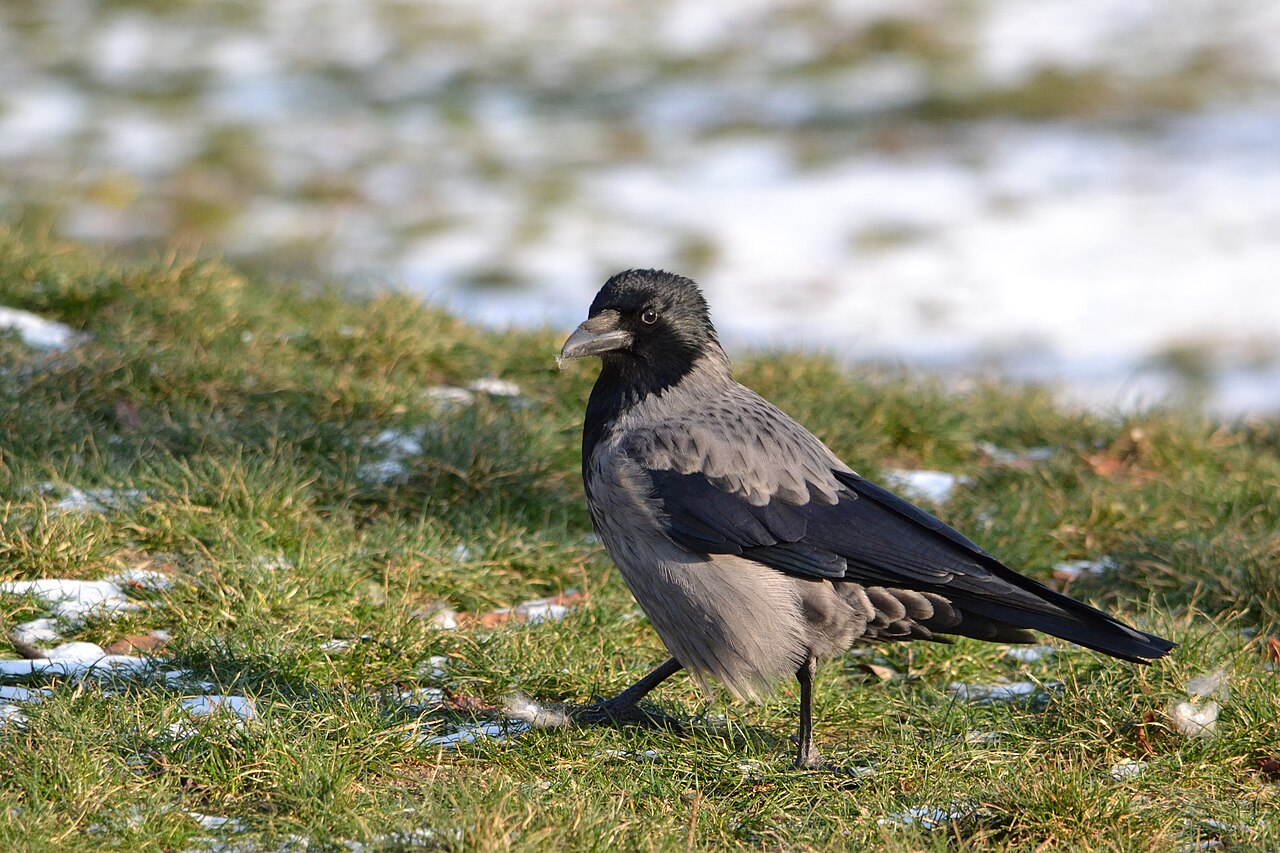
The Hooded Crow, Corvus cornix, is a member of Corvidae approximately half a metre long. It usually combines a grey body with black head, throat, wings and tail, plus a dark bill and legs. The sexes look alike; size variation rarely allows a single bird to be sexed confidently. Juveniles are less glossy and their grey plumage can look slightly brown. Distribution of colour, bill structure and tail shape are more useful than size alone.
Similar birds and taxonomic boundaries
House Crow, Corvus splendens, present in some Arab coastal cities, has differently distributed grey and a slimmer build. Larger black ravens lack the same grey mantle. Hooded and Carrion Crows can hybridise where their European ranges meet. Iraq’s capellanus requires particular care: some lists include it within Corvus cornix, whereas OSME treats it separately as a taxon whose independence merits investigation. It has very pale areas and a relatively large bill. Its southern populations are therefore distinguished here from northern grey Hooded Crows rather than presenting the taxonomic disagreement as settled.
Habitat, food and behaviour
Farmland, pasture, woodland edges, coasts, parks and settlements all provide habitat. This flexible omnivore eats invertebrates, grain, fruit, carrion and discarded food, and may take small vertebrates, eggs or chicks. Dietary proportions vary among places and seasons. Birds walk while searching and inspect resources carefully; some food may be cached. Harsh cawing is characteristic. Pairs defend nesting territories, while groups and communal roosts may form outside breeding. Occurrence at a rubbish dump does not mean that refuse is the entire diet.
Breeding and development
A large stick nest, lined with softer material, is built in a tree, on a rocky ledge or on a suitable structure. Typical clutches contain 3–6 eggs; the female incubates for approximately 18–19 days. Both parents feed chicks, which leave after about a month and continue begging. One brood is usual, with replacement attempts possible following failure. Timing varies: Lebanon records breeding from late February to late July, while an Ismailia study in Egypt reported an earlier January–April season.
Arab occurrence and seasons
The species is a common resident breeder in Lebanon and also breeds as a resident in northwestern Jordan. Egypt supports residents in the Nile Valley and Delta, Faiyum and the Suez Canal area: their appearance is not a signal that migration has begun. Northern Iraq has resident populations, while capellanus occupies the plains, date orchards and marshlands of central and southern Iraq. Rare occurrences of that Mesopotamian form in Kuwait and the United Arab Emirates do not establish resident populations. A few Hooded Crow records from northwestern Saudi Arabia contrast sharply with its Egyptian and Lebanese status. Some northern populations move seasonally, but residency characterises many Arab examples.
Ecology and conservation
Invertebrate and carrion consumption, together with predation on other animals, connect this crow to food webs. Global references describe Least Concern, without settling the status of every population or disputed taxon. Accessible refuse can alter abundance and distribution and increase conflict with people. Waste management, habitat protection and locally evidenced assessment are more useful than universal labels of beneficial or harmful. A single observed nest predation event cannot demonstrate collapse of another bird population.
References
BTO — BirdFacts: Hooded Crow
OSME — Region List 10.2, passerines
Ramadan-Jaradi and colleagues — Updated checklist of the birds of Lebanon, 2020
University of Reading — Birds of Faynan, Past and Present
Mostafa and colleagues — Population estimation and biology of Hooded Crow at Ismailia, 2015
Fazaa and colleagues — Distributions and Community Composition of Birds in Iraq’s Central Marsh, 2017
Molecular Ecology — Population structure and introgression in the Corvus corone complex, 2025
NCBI Taxonomy — Corvus cornix capellanus
Photo: Nicolas Weghaupt — CC0 1.0.