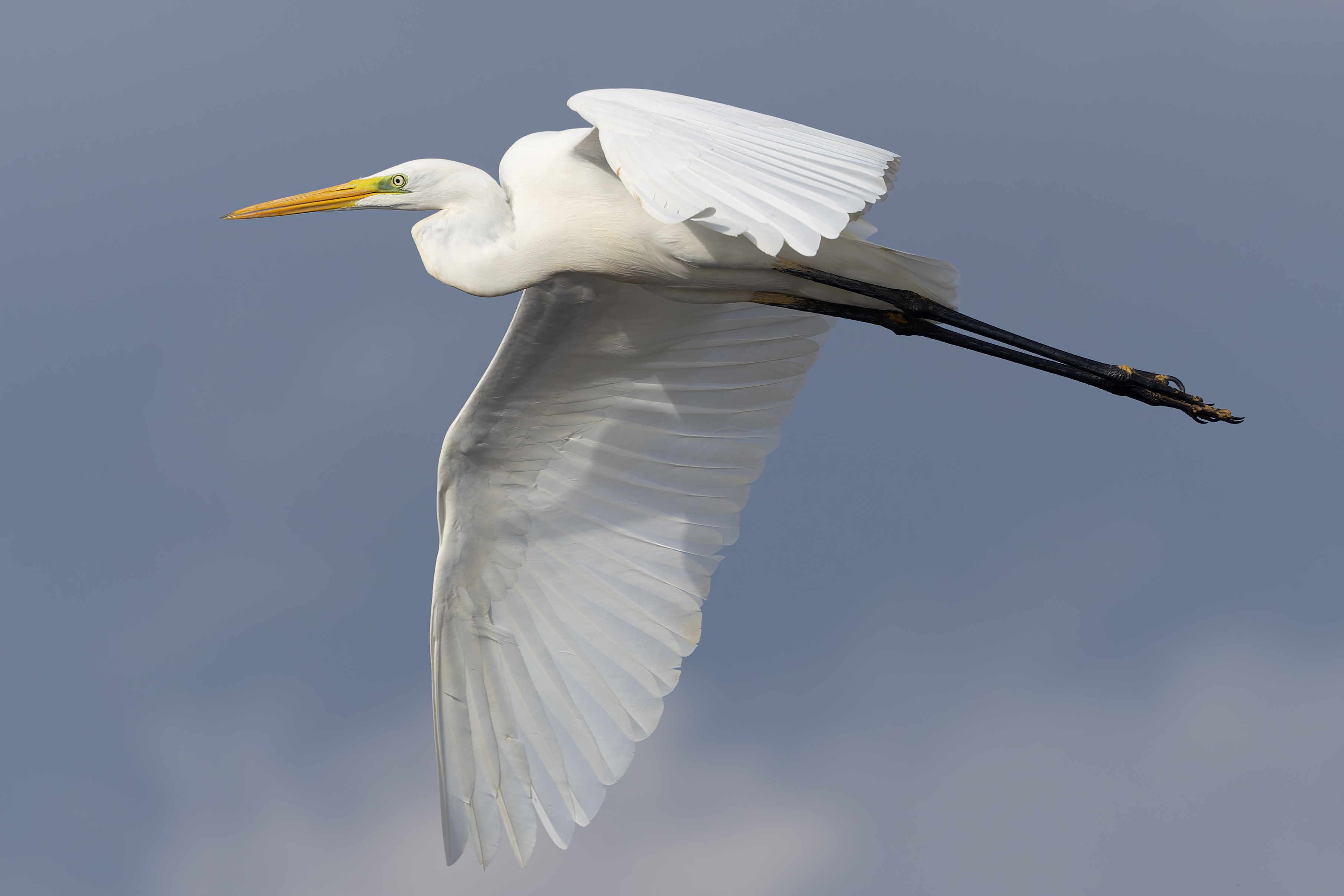
Ardea alba — Identification, habitats, breeding and occurrence in the Arab region
Identity and identification
The Great Egret, Ardea alba, is a large white heron in the family Ardeidae, order Pelecaniformes. Its slender silhouette combines a very long neck, long legs and a dagger-shaped bill. European birds measure approximately 85–102 cm in length, with a wingspan of 140–170 cm; measurements vary geographically.
Plumage is white in both sexes and at all ages. Males average larger, but size alone rarely allows reliable sexing in the field. Juveniles resemble nonbreeding adults and lack the long ornamental back plumes. The bill is generally yellow outside breeding; breeding birds of the Eurasian population can develop a largely black bill, greenish facial skin and brighter upper legs. Bill colour must therefore be interpreted with season and population, not used as an absolute rule.
Compared with Little Egret, it is substantially larger, longer-necked and lacks that species’ conspicuous yellow feet and paired nape plumes. Cattle egrets are stockier and shorter-necked. Intermediate-sized white egrets demand closer examination: in Great Egret the gape extends behind the eye. In flight the neck is folded and the legs trail behind, unlike the extended neck of a flying stork or spoonbill.
Habitat, food and behaviour
It uses freshwater marshes, lake margins, rivers, flooded fields and fishponds, but also lagoons, estuaries and coastal wetlands. Accessible shallow water matters more than whether a site is entirely natural. Dense reeds, trees and shrubs provide nesting or resting cover.
A bird often waits motionless or walks slowly before striking at prey. Fish are important, supplemented by amphibians, aquatic invertebrates and occasionally small terrestrial vertebrates. It may feed alone or among other waterbirds, while defending a profitable feeding patch. Communal roosting does not mean that individuals cooperate while hunting. Flight is steady and deliberate; harsh calls are especially noticeable around colonies.
Breeding and life cycle
Breeding timing follows local conditions: spring and summer in temperate areas, with rainfall and water availability more influential farther south. Nests of sticks or reeds occur in trees, bushes or reedbeds, singly or in colonies. Courtship includes displaying the fine back plumes. A typical clutch contains 3–5 pale blue-green eggs; both parents incubate for about 25–26 days and feed the young. Young birds can climb outside the nest before they fly, usually at around six weeks. Nest departure and independence are not the same event.
Distribution and regional seasonality
The broadly defined species occupies extensive parts of the Americas, Africa, Eurasia and Australasia. Northern populations migrate; others disperse or remain near suitable wetlands. Arabia chiefly receives passage and winter visitors. In the Mashriq, Lebanon has passage and wintering birds, with occasional nonbreeding summer records. Egypt is principally a passage and wintering area. In the Maghreb, Moroccan and Tunisian wetlands support winter visitors and migrants; summer presence alone does not establish breeding.
Ecology and conservation
As a predator it links aquatic prey to wetland food webs. Global status is Least Concern, not a guarantee of local security. Drainage, altered water regimes, contaminated runoff and disturbance can degrade feeding or nesting sites. Protection needs both safe colonies and surrounding feeding habitat. Historical plume hunting illustrates how demand for ornamental feathers can damage populations. Observe from a distance and never approach a colony to obtain a closer photograph.
References
AviList. Annual AviList Update, v2026.
Cornell Lab of Ornithology. All About Birds: Great Egret, identification and life history.
Observatoire FAUNA / INPN. Ardea alba: fiche espèce.
National Parks Board Singapore. Ardea alba.
British Trust for Ornithology. BirdFacts: Great White Egret.
OSME. Region List, version 10.1, 2024.
Ramadan-Jaradi and collaborators. Updated Checklist of the Birds of Lebanon. Sandgrouse 42, 2020.
Rihane, A. Observations de Grandes Aigrettes près de Mohammedia. Go-South Bulletin 11, 2014.
Thévenot and Bergier. La Grande Aigrette au Maroc. 2008.
BirdLife South Africa. Great Egret. Regional Red Data Book, 2025.
Photo: Hobbyfotowiki — CC0 1.0.