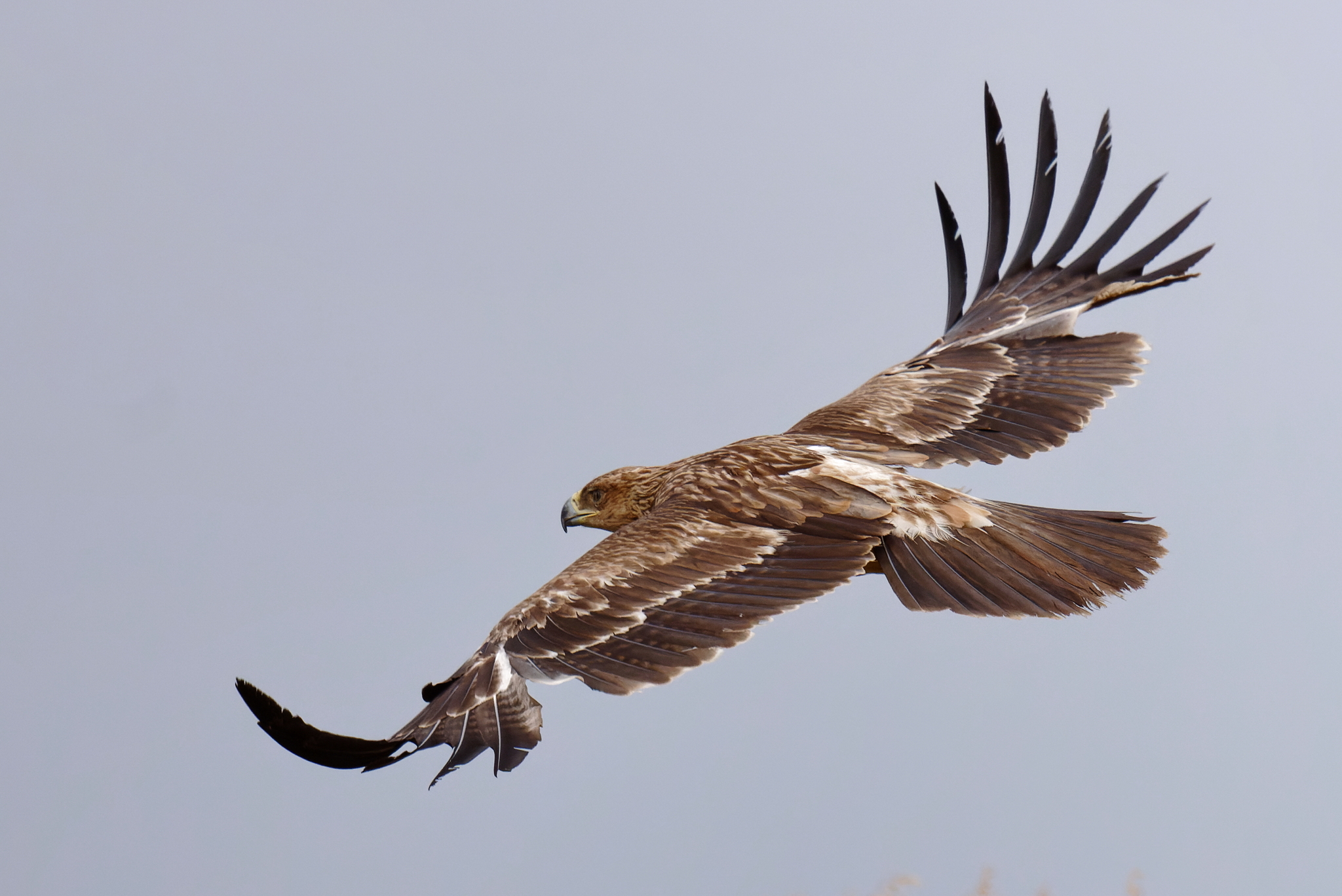
Aquila heliaca
Identity and identification
The Eastern Imperial Eagle is a large Accipitridae raptor. Adults have a dark body and pale golden nape, usually with white shoulder patches; juveniles are paler and more streaked. AviList 2026 treats it separately from the Spanish Imperial Eagle Aquila adalberti.
Habitat and food
It favours landscapes combining trees with pasture and open fields, taking small mammals and birds and also using carrion. Eagles need suitable resting and nesting trees as well as extensive feeding habitat.
Breeding and development
The Bulgarian Society for the Protection of Birds LIFE project describes a tree nest built of sticks and usually two eggs. Incubation takes about 43 days, mainly by the female, with male food delivery and relief. Young continue to receive food and learn to hunt after leaving the nest; first flight is not independence.
Arab occurrence and seasonality
Lebanon’s 2026 guide records rare passage in late February–mid-April and mid-September–October, without describing regular wintering. Qatar’s list gives rare passage. Oman’s official 2026 list instead describes common to abundant passage and winter visits, making Oman’s winter presence particularly relevant in November.
Observation and conservation
The Eastern Imperial Eagle is globally classified as Vulnerable (VU) on the IUCN Red List. Reducing power-line hazards, poisoning and disturbance supports its conservation. Maintain observation distance and do not disclose nest or roost locations.
References
AviList Core Team — Global Avian Checklist v2026, 20 October 2026؛ UNDP / ABCL / Ministry of Environment — Birds of Lebanon: A Photographic Guide to 409 Species, 18 June 2026؛ Qatar Bird Observation Group — Qatar Bird List, consulted 6 November 2026؛ Oman Bird Records Committee — Oman Bird List v8.0, 1 January 2026؛ Bulgarian Society for the Protection of Birds / LIFE — Imperial Eagle: Biology
Species illustration: Лариса Артемьева — CC0 1.0.