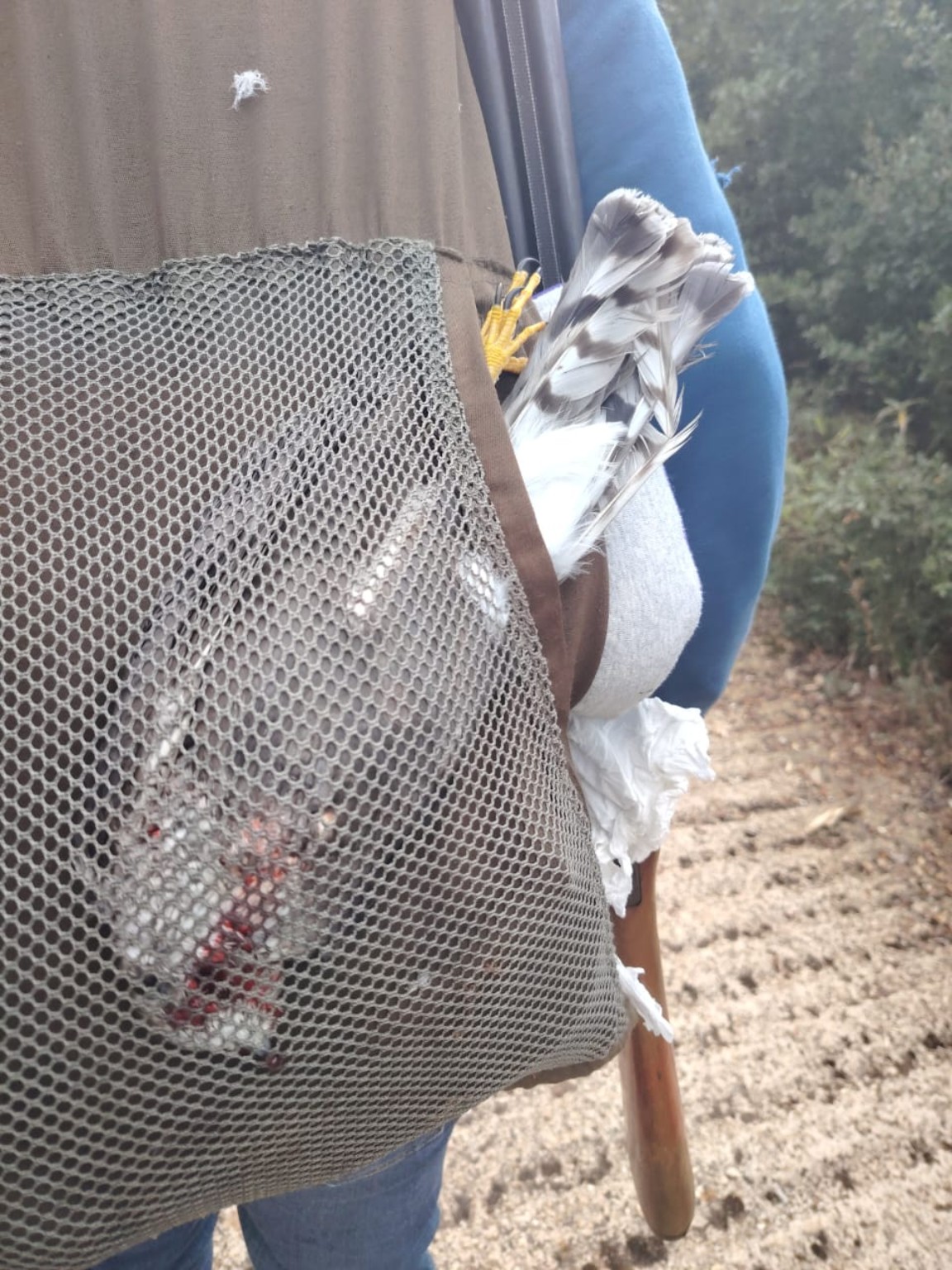
In the highlands of Akkar, a backpack held an unexpected cargo: a sparrowhawk. One of two men detained by security forces was carrying the bird inside his bag during a field operation against the hunting of birds of prey, announced by the Committee Against Bird Slaughter, CABS, on 6 October 2026.
The incident took place in a mountainous area of Akkar, following surveillance by CABS in cooperation with the Middle East Centre for Sustainable Hunting and Anti-Poaching, MECSHAP, and the security forces. According to the organisation, both men were taken to the police station, their weapons were confiscated and legal proceedings were initiated against them.
The backpack is the detail that stays with the reader: a bird of prey, whose domain should be the sky, concealed among belongings carried on someone’s back.
The published information does not establish that the Akkar incident was part of cross-border trade. It does, however, open a window onto other, separate cases in which concealing a bird is the beginning of the story, followed by an attempt to conceal its origins.
In Spain… A Backpack Becomes Part of a Court Case
On 14 October, SEO/BirdLife announced that it had joined criminal proceedings as a private prosecutor before Investigating Court No. 11 in Málaga, in the case arising from Operation Bétula. The investigation concerns suspected theft of raptor chicks from their nests, trafficking and forged documentation.
Its participation marks a new legal development in a case whose underlying events took place months earlier.
The operation was announced on 20 July 2026. According to the published account, two sparrowhawk chicks without identification rings were found inside a backpack in a car near Alhaurín el Grande, together with ten metal rings. The investigation examined whether wild-caught birds were being presented as captive-bred.
Here, the backpack is no longer the only object under scrutiny. A ring attached to a bird’s leg and the document accompanying it are supposed to help establish its identity and origin. If they are used to misrepresent that origin, the appearance of legality itself becomes part of the case.
The inquiry included checks on documents associated with CITES, the convention regulating international trade in endangered species, and the collection of samples for genetic tests to verify parentage. Collecting samples does not mean that test results have been issued, just as an investigation is not a conviction.
There was another chapter in the two chicks’ story: coverage of the operation reported that the Guardia Civil’s mountain rescue team returned them to their nest. Questions about the origins of other birds and their accompanying documents remained before investigators.
Goldfinches Bound for Oran
About a month before the legal development in Málaga, a different case emerged at the Spanish port of Alicante. On 11 September 2026, details were published of the seizure of 1,500 goldfinches inside a car preparing to board a ferry to Oran, Algeria.
According to information attributed to the Guardia Civil, the birds were packed into thirty boxes in severely overcrowded conditions, without the required documents.
That large number conceals a loss that matters just as much: the reports said that 90 birds were found dead, another 90 needed care and 1,320 were released. Ninety goldfinches had paid the price before the sea crossing even began.
In Akkar, a bird inside a backpack; in Alicante, hundreds of birds inside a car. The circumstances and numbers differ, but turning a living creature into concealed cargo puts it at risk before it reaches any market.
Another Bag at Baghdad Airport
Earlier in the year, on 2 January 2026, Video News Agency carried a statement from Iraq’s General Customs Authority about a live falcon discovered concealed in an Iraqi passenger’s bag at Baghdad International Airport’s Babylon arrivals hall. The passenger had arrived from the United Arab Emirates.
The report referred to a single falcon and did not identify its species. That detail was absent from the information released about the seizure.
These sources provide no evidence that the three cases were the work of a single network. What links them in this account is the method of concealment, and the questions each raises about the bird’s origins, its papers and the legality of possessing or transporting it.
Earlier Cases Along the Same Route
Goldfinch seizures are not new to Alicante’s port. SEO/BirdLife has cited the seizure of 83 goldfinches there in June 2025, also bound for Algeria.
Earlier still, in 2022, around 2,400 goldfinches intended to be smuggled to Algeria were seized in Oujda, Morocco, according to the organisation’s account. These older incidents help explain why goldfinches recur in discussions of trade across the Mediterranean and within North Africa, without making every seizure evidence of an organised connection to those that preceded it.
Tunisia: Seeking a Response Across Borders
Against this backdrop, Tunisia is hosting an international meeting from 16 to 18 October 2026 to combat the illegal hunting, capture and trade of wild birds. According to an announcement by the Association Les Amis des Oiseaux, reported by Tunisian National Radio, the meeting brings together ten partners from eight Mediterranean countries.
The programme focuses on sharing experience and improving monitoring, documentation and cooperation, particularly between North Africa and the Balkans. The Association Les Amis des Oiseaux and its partners are involved in organising the meeting, alongside institutions working to protect birds and natural habitats.
The meeting’s importance becomes clear when these cases are considered together: field surveillance stops an offence, an inspection prevents a shipment from leaving, and an investigation looks beyond a ring or a document. Each step has a role, but protecting a bird does not end when it is taken out of a bag.
A backpack may be opened in Akkar, a car at a Spanish port or luggage at Baghdad airport. The question remains open: when will bird smuggling and the illegal trade in birds end?
Sources: CABS · SEO/BirdLife · Bétula · Málaga Hoy · Diario de Alicante · SEO/BirdLife · 1,500 · Video News Agency · Radio Nationale Tunisienne.
